Craigmillar Castle and the Craigmillar Bond
“…lifting here and there its grey turrets above the foliage, silent. lonely and sublime. It stands the sovereign of the scene and seems to frown defiance on all who invade its solitary domain…‘
A Description of Craigmillar Castle, Charles Mackie, 1835
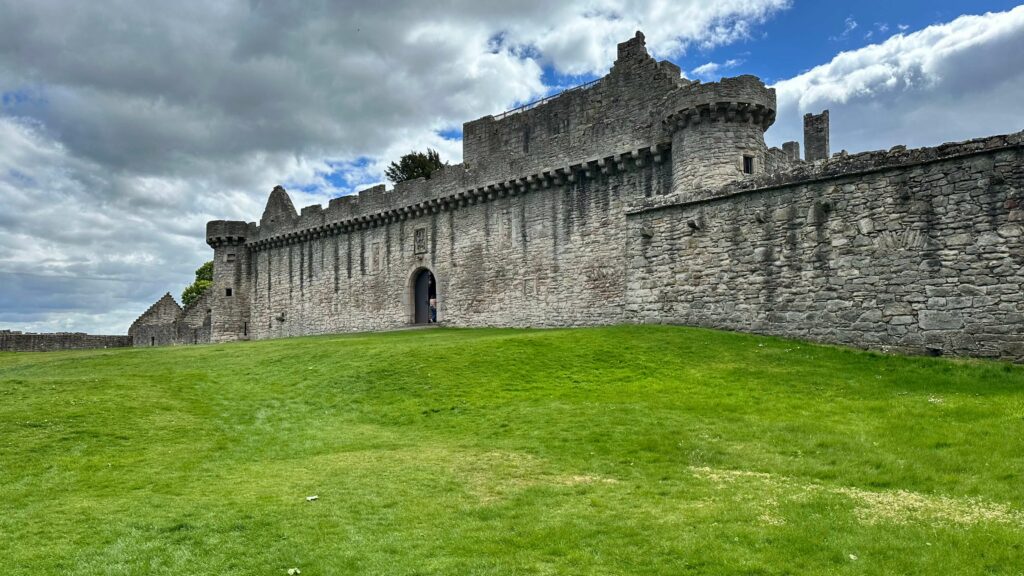
Craigmillar Castle plays a pivotal role in one of the most disturbing and consequential events in Mary, Queen of Scots’s life. It was said to be here, between 20 November and 7 December 1566, that a plot was hatched by a group of Mary’s councillors to rid the Queen (and by implication, themselves) of Mary’s second husband, Henry Stewart, Lord Darnley, King of Scotland, since his marriage to Mary the previous July. It has become known as the ‘Craigmillar Bond’, although no document survives of the clandestine discussions held in the castle’s candlelit chambers.
Mary had no doubt been physically attracted to Darnley when they had first met. She described him as ‘the lustiest and best proportioned long man that she had seen’. However, the veneer of Darnley’s courtly polish had quickly worn off once marriage vows had been exchanged in July 1565. He soon revealed his true character as an arrogant, vainglorious, ill-tempered, and dissolute drunkard. Thomas Randolph, Elizabeth I’s English ambassador to the Scottish court, was an eyewitness to Darnley’s worst excesses. In his dispatches back to England, he describes the King as ‘so very proud that he thinketh himself not honoured nor esteemed as he would be…’ and more pointedly, ‘He is not yet able to govern himself, much less to rule others.’
In short order, Darnley became furious that Mary had denied him the Crown Matrimonial. He was determined to subjugate his wife to what he perceived as natural obedience to him as her husband. His anger and petulance were only inflamed by jealousy over Mary’s relationship with her private secretary, David Rizzio. The King’s flaky character made him vulnerable to becoming embroiled in a savage plot to brutally murder Rizzio, a dastardly deed that took place in front of a heavily pregnant Mary in her private apartments and Holyrood House on Saturday, 9 March 1566.
Soon, the men Darnley had schemed with turned against him, and a second assassination plot to permanently remove this almost universally loathed nobleman was hatched at Craigmillar Castle the following year. More on this shortly. In the meantime, let’s explore the history and appearance of one of Scotland’s most impressive late-medieval castles, the place where the subterfuge unfolded.
Craigmillar Castle: A Favoured Royal Retreat
Craigmillar Castle was largely built during the early fifteenth century by the Preston family, and then rebuilt following the English raids associated with the infamous ‘Rough Wooings’ of the infant Mary, in the second half of the sixteenth century. According to Mary’s biographer John Guy, the castle was one of Mary’s favourite retreats; the queen lodged here for days and sometimes weeks at a time.
One Victorian antiquarian and visitor to Craigmillar Castle writes poetically that ‘From its battlements, a magnificent panoramic scene meets the gaze of the observer. To the north towers venerable Arthur’s Seat, beneath whose shadow Duddingston Church and Loch lie calm and peaceful. A little to the west, the metropolis, with its castle and numerous spires, stands out in bold relief. In the distance is the Firth of Forth, ever widening towards the ocean, with the Bass Rock and North Berwick Law conspicuously prominent. Behind are Liberton Kirk and parish, Gilmerton, Straiton, and various other villages; the whole being bounded by the Pentland, Moorfoot, and Lammermoor ranges.’
The castle was situated just three miles south-east of Edinburgh on the edge of Holyrood House park. In Mary’s time, the lush parkland and verdant surroundings of Craigmillar created quiet isolation and a perfect place to retreat and escape the pressures of court – or to convalesce. The latter is primarily why Mary was in residence at Craigmillar Castle when her Lords plotted Darnley’s downfall.
Layout of Craigmillar Castle
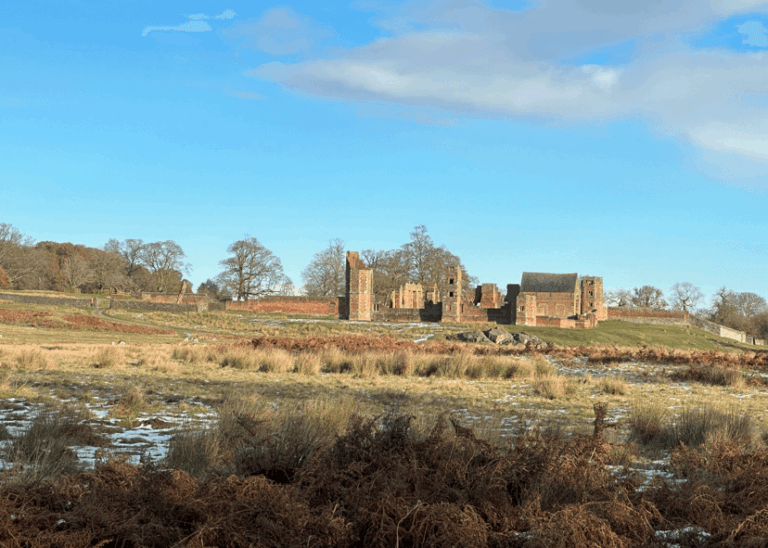
The core of the castle consists of a square tower or keep (in place by 1425), which is several storeys high (about 70 feet from its base to the roof) and connected to a group of smaller ranges. These included the east and west ranges, looking out over the east and west gardens, respectively. At each corner are round turrets, with the complex enclosed by a machicolated wall (built slightly later than the original tower, but likely before the early 1450s). This 30-foot-high wall created an inner courtyard, as shown in the diagram below.
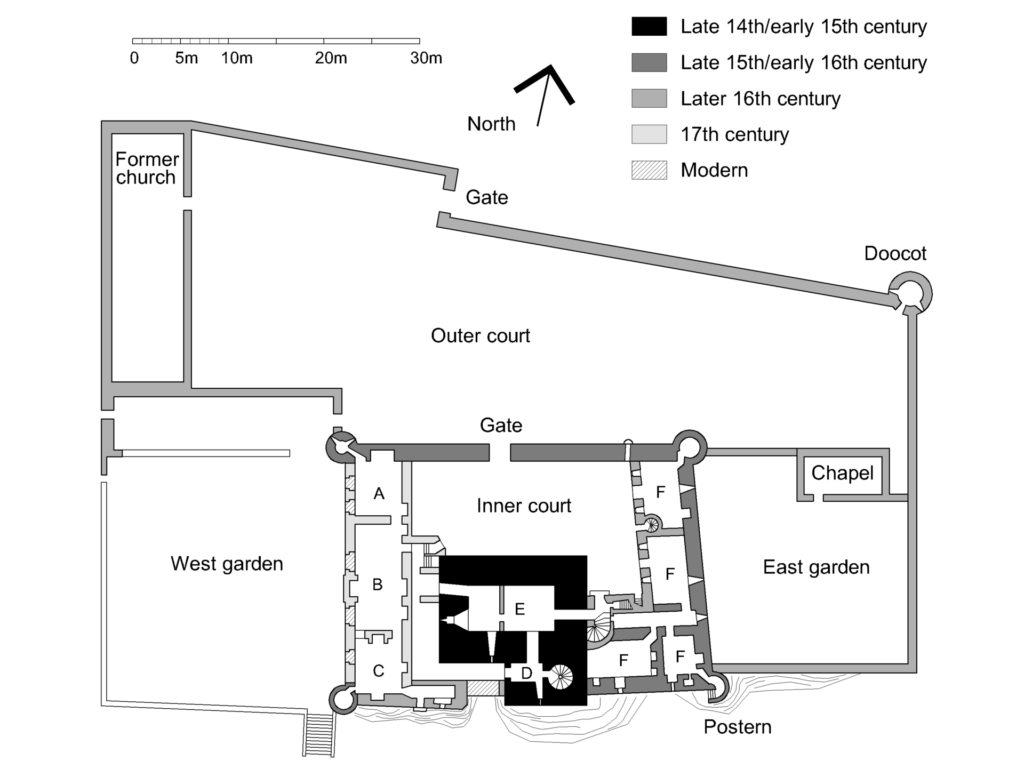
Early in the sixteenth century, circa 1511, a second wall was built around the entire site, creating a second, outer courtyard enclosing an area of about one-and-a-quarter acres. A gate entered this courtyard to the north of the castle. The fact that it is sited at an odd angle, not directly in front of the gatehouse entrance to the inner courtyard, is likely a defensive one. The chicane prevented any would-be attacker from making a headlong assault on the castle’s innermost sanctum.
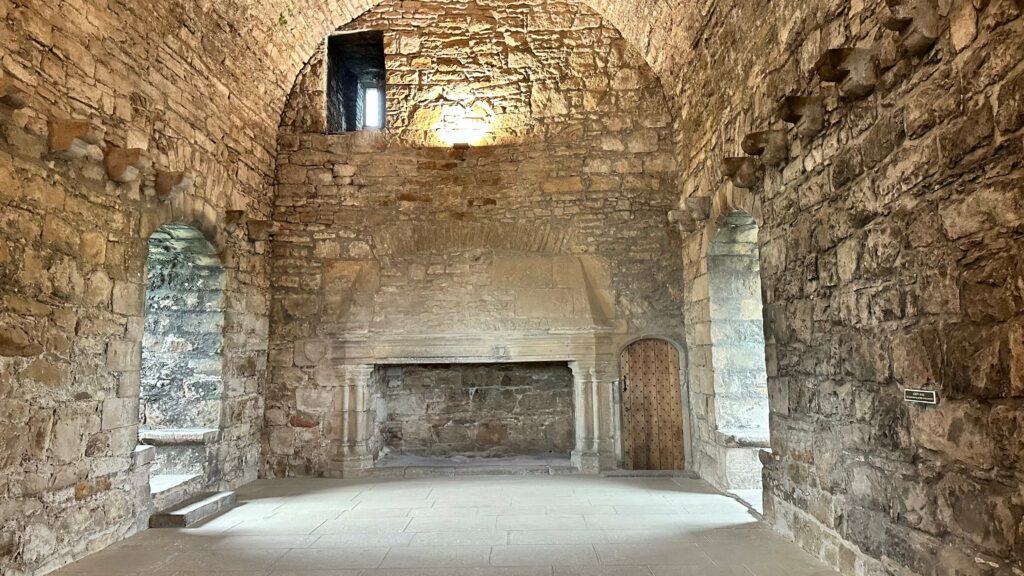
Inside the great keep, the ground floor consists primarily of a vaulted chamber – one assumes for storage. However, the more interesting of the castle’s rooms begin on the first floor.
A spiral staircase leads to a spacious, well-lit hall measuring 36 feet long and 22 feet wide. Beneath a semi-circular, stone-vaulted ceiling, an immense fireplace can be found in the east, or upper end, of the hall. This spectacular specimen measures 11 feet across and no doubt kept the most important diners toasty-warm during cold Scottish winters. The walls of the hall are roughly 9 feet thick and are pierced on the north, south and east sides with recessed window seats. These allowed guests to admire the view, talk in private, or play games such as “the walls of Troy”. Indeed, an account of Craigmillar by a mid-nineteenth-century visitor describes how one of the stone benches that line the recesses of the windows is engraved with a diagram for playing this popular board game.
(Note: Visited Craigmillar in 2026, and there was no longer any evidence of this board game carved into any of the stone seats as described in earlier, Victorian accounts. Possibly this has weathered away. However, if you are interested, for an AI-generated description of the ‘Walls of Troy’ see the footnote ot this blog).
In times gone by, Victorian visitors to the castle were led to believe that one of the tiny chambers leading off the Great Hall was “Queen Mary’s Room.” This has now been relabelled as a small kitchen serving the hall beyond. In fact, the Scots Queen’s lodgings were almost certainly in one of the two ranges built to the east and west of the Tower. By the mid-sixteenth century, just as in England, keeps or towers were seen as outdated, cramped and unsuitable for lodging the laird and his most important guests. The Renaissance introduced the idea of suites of rooms comprising a number of linked chambers, sometimes en filade, and often including a presence chamber, privy chamber, bedchamber, and closet, all of decreasing size but increasing intimacy and privacy.
The now roofless east range fits the bill. It comprised three storeys, with the most luxurious apartments on the first floor. Here, in the sixteenth century, we would have been able to walk through a series of three spacious but progressively smaller chambers, making up a suite of lodgings fit for the most high-status visitors. According to Historic Environment Scotland, the east range contained the best-appointed chambers in the castle. Even today, we can still see the most impressive fireplace surrounds and the largest windows hewn into the crumbling walls.
So, it is here that we might imagine Mary recovering from one of the most dramatic, shocking and draining years of her short life. Ensconced in her privy chambers, with the penetrating winter chill kept at bay by roaring fires, we might imagine the Queen working her needlework alongside her ladies, her still beautiful, if not drawn, features illuminated by the flames flickering in the hearth, while elsewhere in the castle, her conniving Lords plotted the murder of her husband.
The Craigmillar Bond: The Unspoken Bargain
Whether Mary knew about the plot to assassinate her husband is a moot point. We simply don’t know. However, what follows is an outline of the events that unfolded in the quiet corridors and shadowy corners of Craigmillar Castle…
After the murder of Rizzio in March of that year, the difficult birth of her son in June, and embroiled in the apparently never-ending toxic relationship with Darnley, Mary withdrew to Craigmillar, exhausted, traumatised and likely depressed. We have a contemporary account from Le Croc, the French Ambassador who was staying at nearby Holyrood when Mary was in residence at Craigmillar. He wrote:
“The Queen is for the present at Craigmillar, about a league distant from the city. She is in the hands of the physicians, and I do assure you is not at all well; and I do believe the principal part of her disease to consist of a deep grief and sorrow – nor does it seem possible to make her forget the same. Still she repeats these words, ‘I could wish to he dead.’ We know very well that the injury she received is exceeding great, and her Majesty will never forget it. . . . To speak my mind freely to you – but I beg you not to disclose what I say in any place that may turn to my prejudice, I do not expect upon several accounts any good understanding between them, unless God effectually put to His hand.”
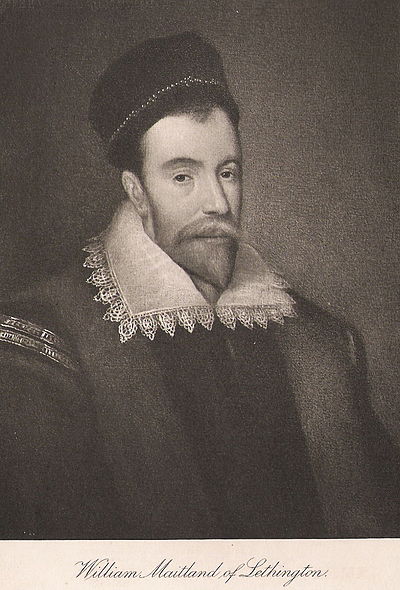
With David Maitland, Mary’s erstwhile secretary and Privy Councillor, spearheading the plot, at some point during her 17-day stay at the castle, Mary was approached by her Lords. They proffered a solution to the Darnley problem, suggesting a divorce as a way to rid herself of her loathsome husband. Her reply was that she might consider it, ‘under two conditions she might understand the same – the one, that the divorcement were made lawfully; the other, that it war not prejudice to her son – otherwise her hyness would rather endure all torments, and abyde the perils that might chance her in her grace’s lifetime.’
However, the Lords aimed not only to rid the country of Darnley because of his loathsome character. The backdrop was far more complicated than that. As part of their grand plan, they needed the co-conspirators of the Rizzio murder pardoned to pave the way for the return of James Douglas, 4th Earl of Morton.
Since the assassination of David Rizzio, eight months earlier, the realm had become increasingly destabilised, aggravated by the King’s erratic behaviour, endless demands and determination to reassert Catholic dominance. In addition, his insistence on being granted the Crown Matrimonial inflated the power base of his Catholic Lennox family in a court seething with jealousy and a ruthless quest for dominance, and where the new-fledged Protestant religion still felt profoundly threatened by those following the old ways of the Holy Roman Catholic Church.
As far as Mary’s Lords were concerned, the power had shifted too far in favour of the Lennoxes. However, as John Guy states, they also feared the King’s Lennox family. To counterbalance this, they needed a strong Protestant Lord who could be relied upon to act decisively and to absorb or deflect blame if necessary. Morton fitted the bill. Not only was he a devout Protestant, but he had also played a central and decisive role in the assassination of Rizzio – and had been prepared to pay the price for it in his exile.
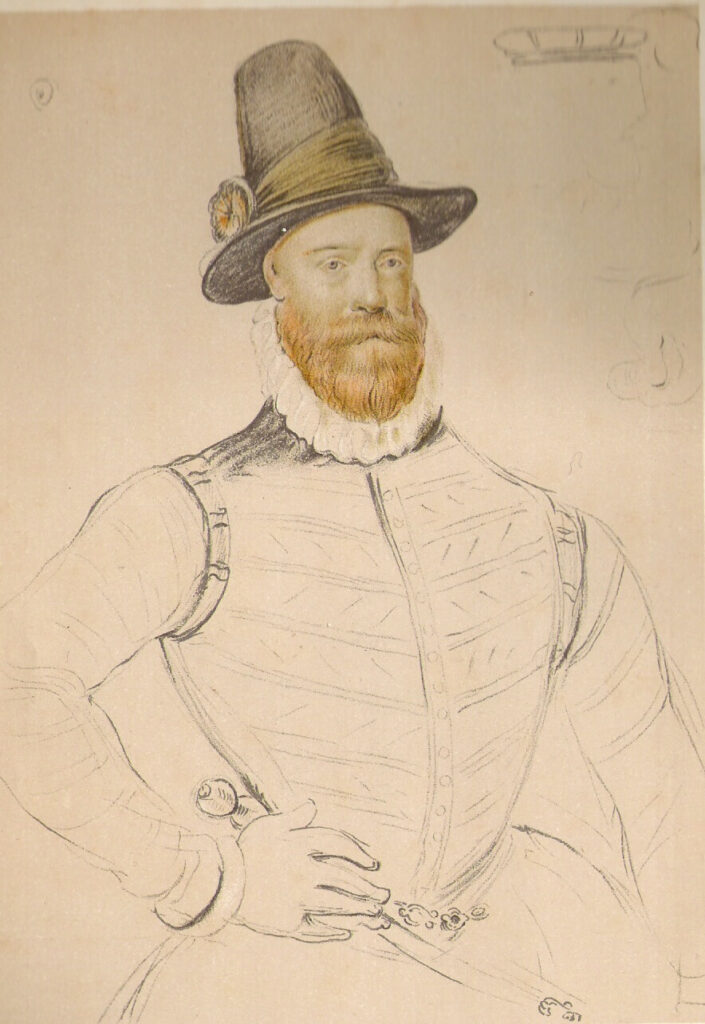
Perhaps Maitland’s grand plan, Guy states, was, firstly, for Mary to divorce Darnley and secondly, for Parliament to bring the ex-monarch to justice through trumped-up treason charges. However, it seems that the language used to Mary was carefully chosen, the endpoint implied, while the word ‘murder’ or execution’ was never openly spoken of. According to John Guy:
‘Maitland said that if Moray still dissented (meaning: ‘disinclined to get involved’), ‘I am assured he will look through his fingers thereto and will behold our doings, saying nothing to the same.’ At this, Mary became agitated. What did Maitland mean? She quickly replied: ‘I will that ye do nothing whereto any spot may be laid to my honour or conscience, and therefore I pray you rather let the matter be in the state as it is.’
Guy, John. My Heart is My Own: The Life of Mary Queen of Scots (p. 283). (Function). Kindle Edition.
The issue for Mary was that she was closer than ever to securing the long-awaited, coveted agreement from her sister Queen, Elizabeth I, that she would be recognised as the English Queen’s rightful successor in the event of Elizabeth’s death. The two were, for the first time, conversing Queen-to-Queen through their diplomats. Mary wanted nothing to happen that might bring her character into disrepute and jeopardise these delicate negotiations. This is something that, of course, did come to pass just months later when Darnley was eventually assassinated at Kirk o’Field.
Maitland assured his Queen that ‘You shall see nothing but good and approved by Parliament’. The conversation ended. There was no more discussion of the matter at Craigmillar. However, quietly, at the very least, it seems that an understanding had formed among Mary’s Protestant Lords that a permanent solution to the Darnley/Lennox question was needed. It was just a matter of time.
What do you think? Do you think Mary knew about the impending assassination of her husband? Cast your vote in the comments below!
FOOTNOTE: The ‘Walls of Troy’ Board Game
Note: the following is AI-generated.
“The Walls of Troy” is an old Scottish board game, sometimes described as a race or pursuit game, and it belongs to that family of traditional games that sit somewhere between Fox and Geese and early tables/backgammon-style games. You’ll find references to it particularly in 18th and 19th-century Scotland, often as part of a collection of fireside games rather than a commercially standardised product.
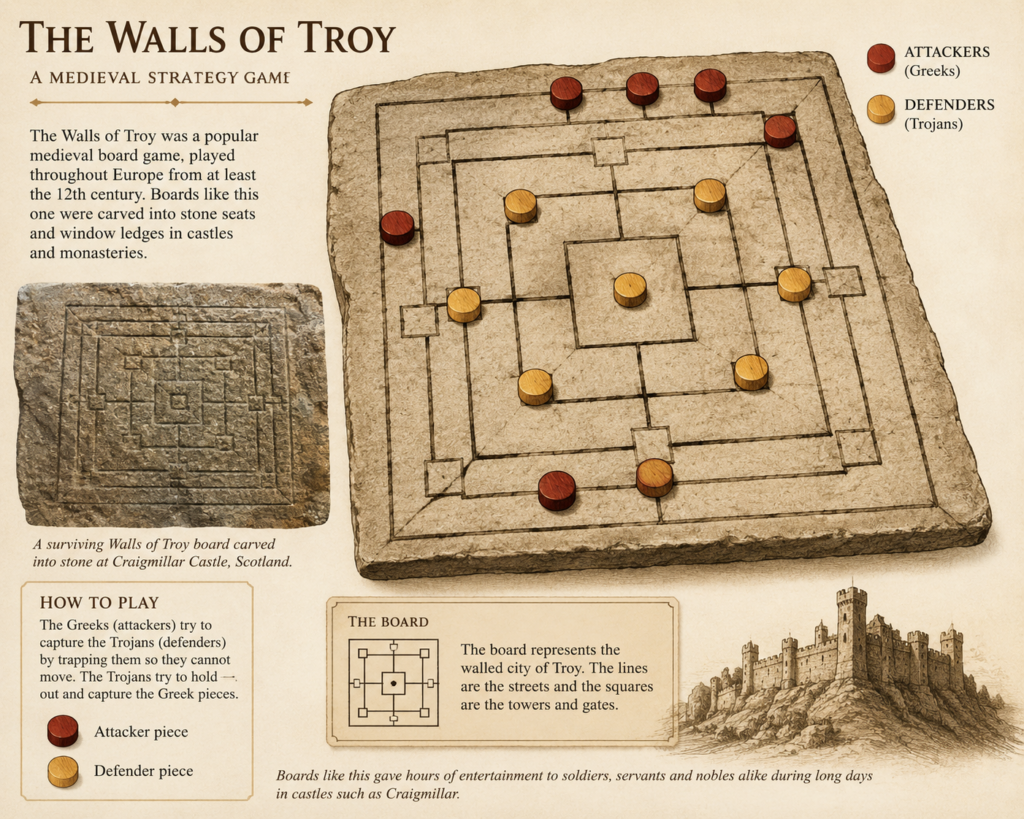
What it looks like
The board is typically:
- A circular or spiral track, sometimes divided into segments
- Marked with “walls” or barriers that create choke points
- Played with small markers or pegs
How it plays (broadly)
The exact rules vary by source, which is part of its charm (and its frustration if you’re trying to reconstruct it precisely), but the general shape is:
- Players race pieces around the track, often toward a central goal or “city”
- Movement is usually determined by dice or throws
- Certain spaces or “walls” can:
- Block movement
- Force players to take longer routes
- Occasionally send pieces backwards
There’s often a sense of siege or approach, which is where the name comes from, evoking the legendary city of Troy rather than strictly recreating the Trojan War.
Cultural flavour
It wasn’t a “mass-produced” game in the modern sense. Think:
- Hand-drawn boards
- Slightly different rules in each household
- Passed along like a recipe rather than a rulebook
It sat alongside other traditional amusements that blended story, chance, and light strategy, perfect for long evenings when the weather pressed in and the world shrank to the glow of a fire.
Sources:
Craigmillar and its Environs with Notices of Topography, Natural History and Antiquities of the District, by Tom Speedy. Selkirk. 1842.
My Heart is My Own: The Life of Mary, Queen of Scots, by John Guy
Craigmillar Castle. Historic Environment Scotland
The Castles, Palaces, and Prisons of Mary of Scotland by Chakres Mackie. London. 1835