Henry VIII, King of England and Lord of Ireland
Name and Titles: Henry Tudor, King of England and Lord of Ireland.
Born: 28 June 1491, Palace of Placentia, Greenwich, England
Died: 28 January 1547 (aged 55), Palace of Whitehall, Westminster, England
Buried: St George’s Chapel, Windsor.
Henry Tudor was never meant to be King of England. He was the second son of Henry VII and Elizabeth of York – the ‘spare’ whose time came when his elder brother, Arthur, precipitously died in April 1502.
Arthur was subsequently interred at Worcester Cathedral, close to the high altar. Upon his death, his younger brother, Henry, then aged just 10, became the new Prince of Wales. It was a fateful roll of the dice that ultimately changed English history and wreaked havoc with so many innocent lives.
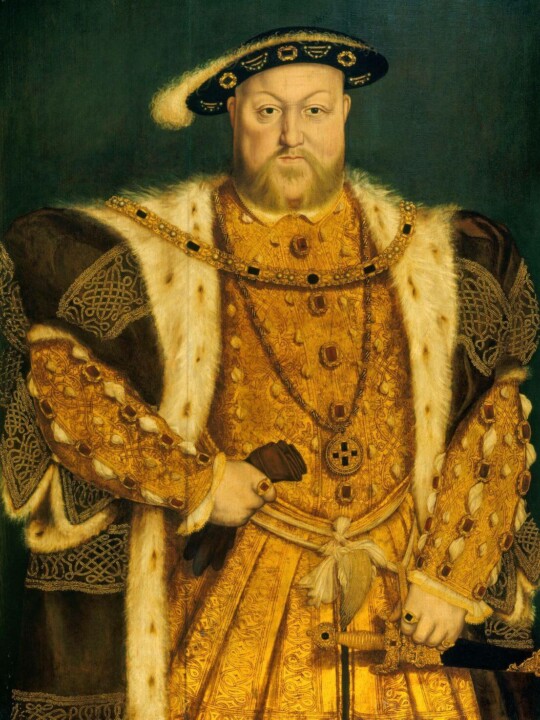
However, this was an outcome no one would have predicted at the start of the reign when the handsome and chivalrous prince, just shy of his 18th birthday, ascended the throne. His father, Henry VII, the founder of the Tudor dynasty, died on 21 April 1508 at Richmond Palace and was interred alongside his beloved wife in a magnificent tomb in the heart of the Lady Chapel at Westminster Abbey, a mausoleum created by Henry VII and intended for his Tudor descendants.
Two months later, Henry VIII was crowned King of England before the high altar, just a stone’s throw from the tomb of his parents.
However, what began as a celebrated and hopeful new start, presided over by a fun-loving, energetic and popular king, would ultimately descend into a reign marked by callous ruthlessness as an ageing, embittered monarch lashed out at friends and foes alike. Many lives were brutally cut short, including those of two of Henry’s six queen consorts – Anne Boleyn and her cousin, Katherine Howard.
As Henry aged, he was plagued by headaches (possibly as a result of jousting accidents) and an ulcerated leg that festered, periodically debilitating the King in agonising pain. In his latter years, Henry became morbidly obese, curtailing a younger spirit that had once been famed for his love of energetic outdoor pursuits. The perceived betrayal of lovers, friends, and perhaps even his own body, created an irascible, brooding and revengeful monarch, prone to fickle moods and dangerous outbursts.
Henry was not able to live to see the majority of his precious and longed-for son, Edward, who was only 12 when his father finally succumbed to death’s warm embrace on 28 January 1547 at the King’s Palace of Whitehall. And while the old King had planned a magnificent tomb for himself at Windsor, where he had chosen to lie next to his favoured wife, Jane Seymour, things didn’t quite turn out as the old man intended…
The Tomb That Never Was…
Never knowingly underselling himself, Henry had always planned a grand funerary monument as befitting a great Christian prince of Europe. Following the fall of Cardinal Wolsey in 1529, he earmarked the marble base, pillars and statues which the Cardinal had already commissioned for his own tomb. The King’s big ideas were captured in a document called ‘The manner of the Tombe to be made for the King’s Grace at Windsor’ (now sadly lost), and it was to be erected in St George’s Chapel, Windsor, where Henry’s grandfather and grandmother, Edward IV and Elizabeth Woodville were already buried as well as the woman who had finally born him a son: Jane Seymour.
It was to be ‘ornamented with ‘fine Oriental stones’ and resplendent with white marble pillars, gilded bronze angels, four life-size images of the King and Queen Jane, and a statue of the King on horseback under a triumphal arch, ‘of the whole stature of a goodly man and a large horse’. In all, there were to be one hundred and thirty-four figures, including St George, St John the Baptist, the Prophets, the Apostles and the Evangelists, ‘all of brass gilt as in the pattern appeareth’.’
At the time of Henry’s death in his bedchamber in the dying days of January 1547, in the Tudor Palace of Whitehall, the tomb was still incomplete, so Henry’s corpulent body was temporarily placed inside a vault under the choir in St George’s Chapel, alongside Queen Jane. There, it would remain despite the King’s grand plans.
King Henry VIII’s Tomb is Lost – and Found!
Although Henry stated in his will that the tomb was nearly complete, wars with Scotland and France in the latter part of his reign had drained the Exchequer, and work slowed. Around the same time, the master sculptor responsible for the job, Rovezzano, returned to Italy due to bad health.
Another sculptor, Benedetto, was commissioned to replace Rovezzano and complete the tomb for the King. However, Henry VIII did not see it finished. Over time, each of Henry VIII’s three children expressed an intention to complete the memorial, but each subsequently failed to do so. Elizabeth I even moved the tomb’s parts to Windsor in 1565, where they remained until 1645-6. Then, during the Civil War, elements of the monument were sold to raise funds for the Crown.
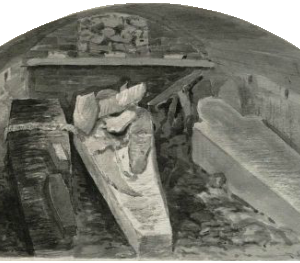
Just three years later, in 1649, the vault containing the bodies of the Tudor King and Queen was opened and the body of the executed Charles I was placed next to Henry’s coffin. (You can read more about this gory but compelling take here). In the same century, the body of a stillborn child of the future Queen Anne was also interred in the vault. These coffins remained undisturbed until the tomb was rediscovered in 1813 during excavations for a passageway to a new royal vault. At this time, A.Y. Nutt, Surveyor to the Dean and Canons, made a watercolour drawing of the vault (see below).
The Wolsey Angels
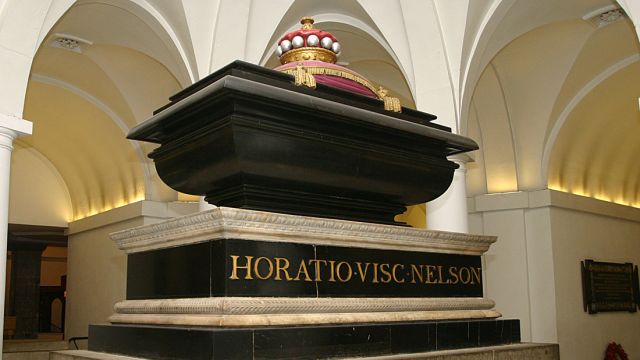
Until recently, only the black stone chest, later used for Admiral Lord Nelson’s monument in the crypt of St Paul’s Cathedral, and four bronze candlesticks, now at St Bavo Cathedral in Ghent, were thought to have survived from the Wolsey / Henry VIII tomb.
However, in 1994, two further angels appeared at auction, unillustrated and catalogued simply as ‘in Italian Renaissance style’. They were acquired by a Parisian art dealer. Later, the Italian scholar Francesco Caglioti convincingly attributed them to Benedetto. In 2008, the remaining pair of angels was discovered at Harrowden Hall, a country house in Northamptonshire, now owned by the Wellingborough Golf Club, where all four angels once stood atop the gateposts.
Having been identified as part of Wolsey’s original funerary monument, the four angels were acquired by the Victoria and Albert Museum in 2015 for £5 million, thereby preserving an important piece of Tudor history for the nation (see more here).
Visitor Information
If you are visiting Windsor Castle, particularly during the tourist season, I highly recommend booking tickets online in advance. You can buy them here. My other top tip for visiting the castle is to get there at the opening time. If you want some peace and the space to allow your imagination to work wonders, I highly recommend you get ahead of the crowds.
Another point to note about Windsor Castle is that, whilst the exterior has remained largely unaltered since the sixteenth century, it is difficult to discern any Tudor character inside; the interiors have been significantly altered over time. If you want to time-travel and see the Windsor that Henry knew, you will find all you need to know in In the Footsteps of the Six Wives of Henry VIII. This covers the Tudor appearance and layout of the royal apartments in the castle, as well as key events that occurred there.
Notes:
Benedetto da Rovezzano (1474-1554) was a contemporary of Michelangelo and was described by Giorgio Vasari as ‘…among our most excellent craftsmen.’ One of his early commissions, in 1508, was to complete Michelangelo’s bronze sculpture of David (now lost), indicating that his metalworking skills were in high demand. He worked in England between 1519 and 1543, during which his pre-eminent patron was Cardinal Wolsey.