Tracing the Tudors Through Herefordshire: A Three-Day Journey Into England’s Border Past
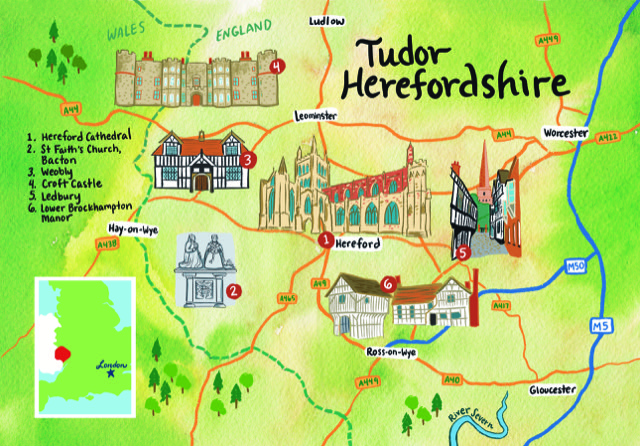
Tucked between the wild edge of Wales and the rolling green heart of England lies a land shaped by power, conflict, and quiet resilience. Herefordshire, once a volatile frontier zone, bears the architectural and emotional imprint of centuries past—none more evocative than the Tudor age. From crumbling castles and timber-framed market halls to sacred textiles and whispering moats, the county offers a journey into the very soul of sixteenth-century England.
This three-day itinerary invites you to trace the footsteps of monarchs, rebels, courtiers, and commoners alike. You’ll begin in Hereford, the county capital, where the blood of Owen Tudor once stained the cobbles. From there, travel to churches that still echo with courtly secrets and villages that time forgot. Discover the homes of powerful families like the Crofts, who played dangerous games of loyalty during the Wars of the Roses, and stand in places where Elizabethan finery once met rural devotion.
Whether you’re a seasoned Tudor traveller or a newcomer to the era, Herefordshire offers a window into the past that is both richly textured and wonderfully alive. So lace up your boots, bring your curiosity, and prepare for an unforgettable journey through time.
Itinerary
- Day One: Hereford and Hereford Cathedral
- Day Two: Weobley and Croft Castle
- Day Three: Ledbury and Brockhampton Manor
Tudor Herefordshire: Day One
hereford: A tudor town on the edge
Hereford, the county town of Herefordshire, owes much of its early—and often turbulent—history to its strategic location just 16 miles from the Welsh border. For centuries, this was the frontier of England, where power and politics collided. During the medieval and Tudor periods, the region was governed by the Marcher Lords, appointed by William the Conqueror shortly after the Norman invasion to defend the kingdom against frequent Welsh uprisings.
During the Tudor era, Prince Arthur, the elder son of Henry VII, became the titular Head of the Council of the Marches, based in nearby Ludlow. The Marcher lands the Council oversaw were notorious for their lawlessness, and the formidable castles built to impose order were regularly tested. Hereford and its surrounding region were no exception.
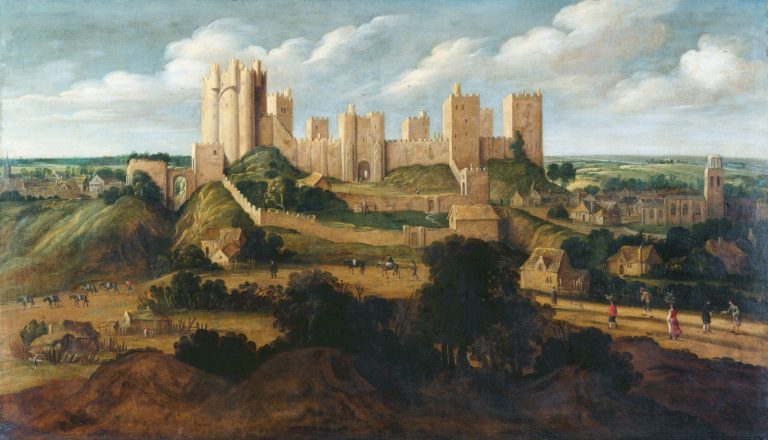
One of England’s earliest castles once stood within Hereford’s city walls, constructed in 1052—almost a decade before the Norman Conquest. When John Leland, the famed Tudor antiquary, visited in the 1520s and 1530s, he described it as “one of the finest, largest and strongest in England,” rivalling Windsor Castle in scale. But even then, the fortress was crumbling. Today, no structure remains above ground, but the broad green sweep of Abbey Park still traces the castle’s former bailey.
Leland also noted the city’s nearly mile-long walls, broken only to the south where the River Wye offered a natural defence. Six gates gave entry to a city bustling with four parish churches, a grand cathedral, a Benedictine monastery, and two friaries: black and grey.
The Battle of Mortimer’s Cross
However, Hereford’s most dramatic link to Tudor history unfolded on a bitter February morning in 1461, following the Battle of Mortimer’s Cross, some 23 miles to the northwest. This early clash in the Wars of the Roses saw the Yorkists, led by the young Edward, Earl of March (later Edward IV), defeat the Lancastrians. Among those captured was Owen Tudor, widower of Katherine of Valois and grandfather of Henry VII.
The next day, Owen was executed in Hereford marketplace. His body was buried at the now-lost Greyfriars monastery, while his head was displayed at the market cross. One contemporary described how “a mad woman combed his hair and washed away the blood from his face, and set 100 candles about him.” A simple stone plaque now marks the site.
Over two decades later, Henry Tudor passed through Hereford en route to challenge the Yorkists at the Battle of Bosworth. Did he reflect on his grandfather’s execution in that same square? Perhaps. His return in 1486, during his northern progress, must have felt quietly triumphant.
Hereford Cathedral
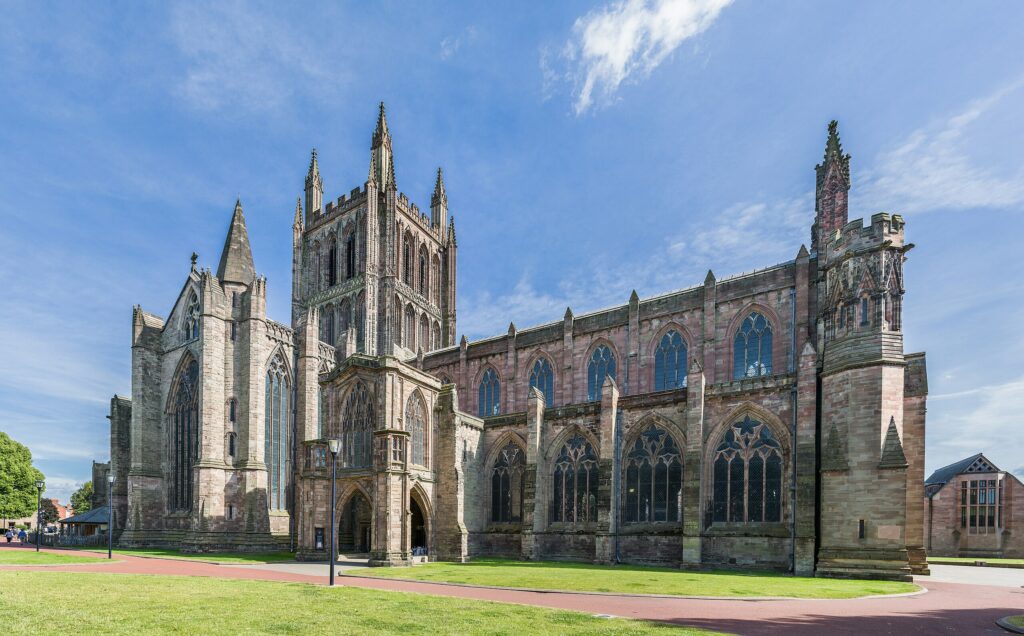
Inside nearby Hereford Cathedral, that Lancastrian legacy endures. Close to the high altar lies the tomb of Bishop John Stanberry, once confessor to King Henry VI. Opposite stands his elaborately carved chantry chapel. But the most poignant memorial is the Elizabethan tomb of Alexander and Anne Denton, the couple depicted lying side by side, Anne cradling the infant who died with her in childbirth when the latter was just 18 years old.
Although they have no direct links to the Tudor period, we cannot leave without noting a couple of the cathedral’s extraordinary treasures: the thirteenth-century Mappa Mundi, the largest surviving medieval map of the world, and one of only four remaining copies of the Magna Carta of 1215. Both are preserved in the cathedral’s chained library—the largest of its kind in the world. The Mappa Mundi is on permanent display via a dedicated exhibition. An entrance fee is payable.
The Decline of Tudor Hereford
The Dissolution of the Monasteries in the 1530s reshaped Hereford. As church lands were sold, wealthy families acquired timber rights, sparking a boom in elegant timber-framed construction. Many of these houses still grace the town today.
One standout is The Old House, a striking black-and-white building in the heart of Hereford’s market square. Built in 1614, it post-dates the Tudor era but echoes sixteenth-century architectural style. Now a museum, its rooms have been faithfully restored with original furniture and everyday objects, offering an immersive glimpse into the past.
However, as the borderlands became more stable and Hereford resisted aspects of Henry VIII’s Reformation, the city’s influence began to fade. Yet its deep Tudor roots, powerful Lancastrian ties, and proximity to Ludlow and Worcester make it a compelling starting point for anyone seeking to walk in the footsteps of the Tudors of this often neglected county.
The Bacton Altar Cloth: Threads of a Queen’s Legacy
In the tiny village of Bacton, a modest church once held one of the most extraordinary artefacts of Elizabethan England—hidden in plain sight. For centuries, a richly embroidered textile adorned the altar (and subsequently, the wall) of St Faith’s Church, admired for its beauty but its true significance unknown. Today, it is known as the Bacton Altar Cloth, now widely believed to be a rare surviving fragment of Queen Elizabeth I’s wardrobe.
The cloth’s royal origins were uncovered thanks to the detective work of Eleri Lynn, Chief Curator at Historic Royal Palaces and an expert in Tudor fashion. Her investigation revealed what many had overlooked: this was no ordinary piece of embroidery. The cloth was sewn with the finest dyed silks, silver and gold thread, intricately worked into a luxurious cloth of silver—a fabric reserved exclusively for the wealthiest in society. The craftsmanship, design, and material all pointed in one extraordinary direction: this cloth was almost certainly once part of a gown worn by Queen Elizabeth I herself, who was said to own more than 2,000 dresses over the course of her reign.
Though no direct document ties this fragment to the queen, the most compelling theory of its journey from courtly splendour to country altar lies with one remarkable woman: Blanche Parry. Born at Newcourt near Bacton, Blanche served the future queen from infancy—rocking her cradle, then later rising to become Chief Gentlewoman of the Bedchamber following the death of Kat Ashley. Blanche held Elizabeth’s trust, and with it, access to her jewels and clothing.
It was common for the queen to bestow garments on loyal attendants, and Blanche was a frequent recipient. After Blanche’s death in 1590, could this magnificent fabric have passed into local hands, later offered to the church in her honour? Perhaps it was transformed into an altar cloth as a gesture of both piety and remembrance.
Today, the original cloth is preserved by Historic Royal Palaces, but a faithful replica is proudly displayed in St Faith’s Church, just 14 miles southwest of Hereford. Beside it stands Blanche’s empty tomb, with its striking monument—one of the earliest depictions of Elizabeth as Gloriana, regal and commanding.
St Faith’s is hushed, unassuming, and full of grace. Sitting within its ancient walls, far from the clamour of court, you can reflect on the quiet power of women like Blanche—whose presence spanned from the queen’s cradle to her most private chambers—and the garment that links them still.
Tudor Herefordshire: Day Two
Weobley: A Time Capsule of Timber and Trade
Day two begins in Weobley (pronounced Web-ley), one of the finest examples of a Tudor village on Herefordshire’s famed black-and-white trail. Located around eleven miles northwest of Hereford, it is a visual feast for lovers of historic architecture.
Weobley is one of those rare places where time seems to have paused. Its medieval and Tudor buildings survive in exceptional condition, largely thanks to economic decline following the collapse of the wool trade. The Industrial Revolution passed Weobley by, inadvertently preserving its pre-modern charm.
Yet, during the medieval and Tudor periods, Weobley was a place of real consequence. In the eleventh century, the powerful De Lacy family built a castle that once loomed over the settlement. The wide marketplace, still at the heart of the village, buzzed with commercial life, its prosperity fuelled by the regional wool trade—referred to locally as ‘Leominster ore’, such was its importance. Weobley also earned a reputation for its ale, as well as glove- and nail-making.
With that wealth came pride—and pride built finely crafted timber-framed merchant houses and bustling coaching inns, many of which still line the marketplace and surrounding lanes. A number of these buildings date back to the fifteenth century, with some constructed even earlier. While several now bear later Georgian or Victorian facades, a good many retain their original wattle and daub exteriors, rich in character and layered with centuries of history.
A walk through the village offers a lesson in vernacular design. From cruck-framed halls to Tudor schoolhouses and even infilled medieval serving hatches, architectural enthusiasts will find much to admire. To guide your visit, a downloadable heritage trail links a series of information boards in a gentle 45-minute loop around the village.
When you’ve completed your walk, return to the marketplace and rest at the welcoming Green Bean Café, a community-run treasure offering tea, coffee, light lunches—and, of course, a generous slice of homemade cake. It’s the perfect end to a stroll through one of Herefordshire’s best-preserved Tudor villages.
Croft Castle: Shifting Loyalties in the Shadow of the Crown
Just twelve miles northeast of Weobley lies Croft Castle, surrounded by ancient woodland and steeped in stories of dynastic conflict and quiet resilience. Seat of the “famous and very knightly family of the Crofts” since the eleventh century, the current house was extensively remodelled in the late seventeenth and nineteenth centuries—but its Tudor roots still pulse beneath the surface.
The most compelling figure in the Croft story is Sir Richard Croft, a courtier, soldier, and political survivor whose fortunes rose and fell with the tides of the Wars of the Roses.
Sir Richard’s friendship with Edward, Earl of March (later Edward IV) began in childhood, when they were schooled together. Their bond was tested in battle—most famously in 1461 at Mortimer’s Cross, fought on Croft land. Richard’s loyalty earned him royal favour and military honours at Towton and Tewkesbury, where he was knighted.
His wife, Eleanor Croft, managed the royal household of Edward IV’s eldest son at Ludlow Castle, just before the prince was taken to the Tower of London—where he would later vanish, becoming one of the so-called ‘Princes in the Tower’. Disillusioned, Sir Richard abandoned his allegiance to Richard III and supported Henry Tudor at the Battle of Bosworth. His reward? Stewardship of Ludlow during Prince Arthur’s residency there.
Sir Richard died on 29 July 1509, and lies buried alongside his wife in the thirteenth-century parish church that stands beside the present-day house. Their stone effigies rest quietly, gazing up from across the centuries.
As for the ‘castle’ itself, it’s something of a romantic masquerade. Rebuilt in 1660 by Herbert Croft, Bishop of Hereford, the house is one of the earliest examples of medieval revival architecture—a fortified manor house rather than a true castle. Built just 30 yards from the original site, it encloses a central courtyard with rounded corner towers and a square bay to the north. Though its interiors are largely Georgian in style, the atmosphere retains something of its storied past.
Croft Castle may not dazzle like some of its more ostentatious counterparts, but it offers visitors something rarer: a sense of continuity. Its pretty gardens, rolling parkland, historic church, and deep-rooted connections to some of the most dramatic turning points in English history make it a quietly compelling stop on any Tudor trail.
Tudor Herefordshire: Day Three
Ledbury: A Timber-Framed Treasure of Tudor Herefordshire
Our final day brings us to Ledbury, a historic market town lying twelve miles east-northeast of Hereford. Almost equidistant from Hereford, Gloucester, and Worcester, Ledbury has long been a crossroads of trade and culture.
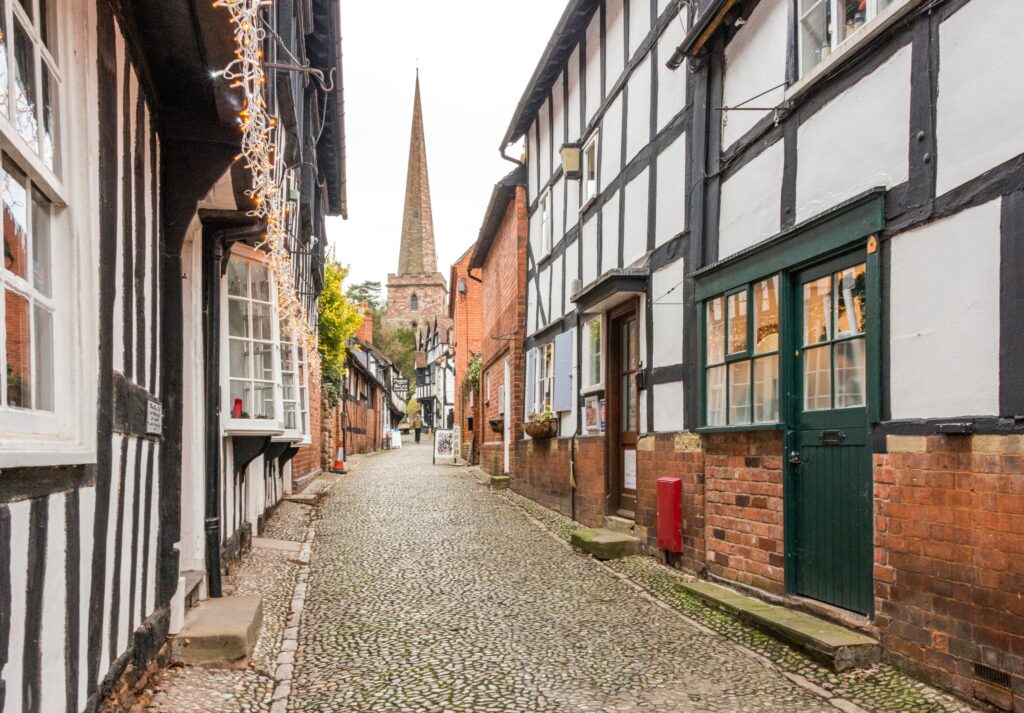
Today, it is celebrated as another of Herefordshire’s quintessential black-and-white towns, where timber-framed buildings line a broad, handsome high street. Many of these medieval and Jacobean façades were revealed only in the twentieth century, when later plasterwork and brick fronts were removed, uncovering the beauty of the original craftsmanship beneath.
By Tudor times, Ledbury was already a thousand years old. It was mentioned in the Domesday Book of 1086 and for centuries was part of the Bishop of Hereford’s estate. This arrangement ended in 1558, when Elizabeth I confiscated the bishop’s manor, transferring it to the Crown. During the Tudor period, the town flourished on the strength of the cloth trade, which brought wealth, civic pride, and impressive architecture. Much of this legacy is tied to three dominant families: the Skynners, Skyppes, and Eltons.
Don’t Miss in LedburY
- St Katherine’s Hospital (c.1231) – A rare, intact medieval hospital complex with a chapel, almshouses, and a timber-framed barn. Located beside the main car park, it’s an architectural gem hiding in plain sight.
- Ledbury Park (New House, 1590) – Described as “the grandest black-and-white house in the country,” this majestic timber-framed building stands on the site of the bishop’s palace. Now used as private apartments, it can only be admired from outside, but its scale alone is worth the detour.
- Church Lane and St Michael and All Angels – A cobblestone medieval lane leads to the town’s grand parish church, filled with 150 ledger stones and tombs. The highlight is the Jacobean tomb of two Skynner family members, shown with their eleven children.
- No. 1 Church Lane – The Painted Room – One of Ledbury’s oldest buildings (c.1510). Its 1988 restoration revealed a stunning set of Elizabethan wall paintings, among the finest in England. Open to visitors free of charge (April–October, Mon–Sat).
Other Highlights
Be sure to take in the Jacobean Market House, an iconic raised hall on sixteen wooden pillars, as well as the historic Talbot and Feathers Inns. Both offer not only classic English pub food but a chance to dine where Tudor travellers may once have rested weary feet.
Brockhampton Manor: A Timeless Gem in a Storybook Valley
The drive down to Brockhampton Manor is a journey in itself—a winding route through the rolling, green tapestry of Herefordshire countryside. As the land dips and folds, anticipation builds. Something special lies ahead. And then, there it is: Lower Brockhampton Manor, nestled like a jewel in a secluded, verdant valley. It may be small, but it is utterly enchanting—perfectly formed and ready to steal your heart the moment it comes into view.
Now part of the Brockhampton Estate under the care of the National Trust, this fifteenth-century timber-framed manor was built in 1425 for the Domulton family. A ruined chapel across the moat hints at even older origins, with records stretching back to the Domesday Book.
Brockhampton’s story is one of quiet domestic life rather than royal intrigue, but that is its charm. It offers a rare glimpse of how ordinary rural gentry lived across the centuries. The timber-framed gatehouse, built in 1540, adds a Tudor flourish—raised at the same time that Kathryn Howard and Thomas Culpepper’s scandalous affair was unfolding in London.
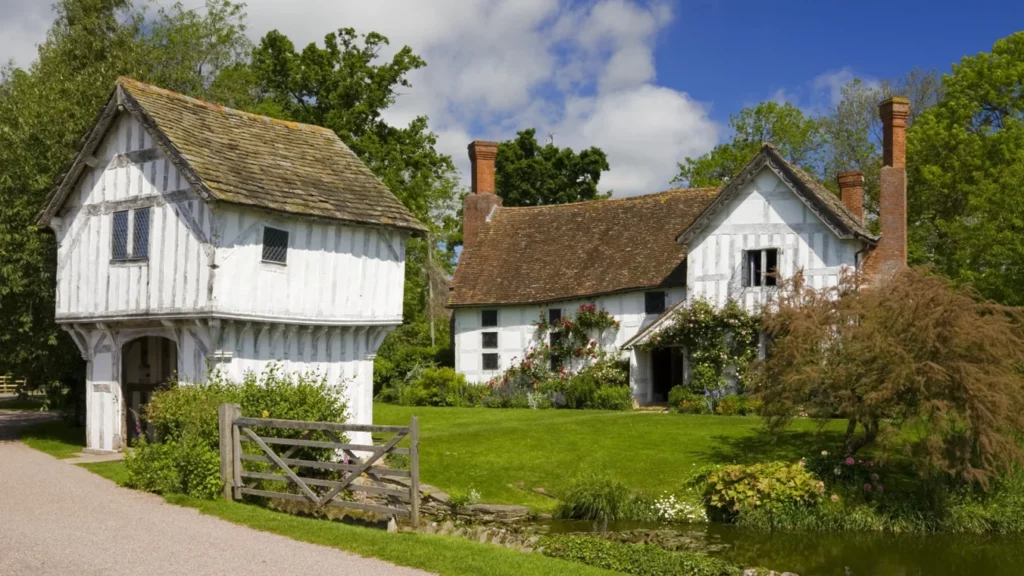
Visitors are guided through time as they wander the house: from the medieval great hall, with its open hearth and heavy beams, through rooms furnished to reflect each century of occupancy, ending in the 1950s sitting room where the last residents lived. Every room feels like a time capsule, frozen in its moment.
There’s something profoundly welcoming about this place. From the Victorian-style kitchen, brimming with cosy nostalgia, to the mirror-like waters of the moat that encircle the house like a protective embrace, Brockhampton wraps around you in the most quietly magical of ways.
And don’t forget to ask the guides for a ghost story or two—they’re more than happy to oblige. Afterwards, as all good time-travellers must, make your way to the converted stable block café, where you can complete your journey with a hot cuppa and a generous slice of homemade cake.
Sometimes, the most memorable places aren’t those where history shouted—but where it whispered. Brockhampton is just such a place.
Drawing the Threads Together
As your journey through Tudor Herefordshire draws to a close, it’s impossible not to feel the quiet pull of the past still echoing in the lanes, halls, and half-timbered houses of this ancient county. This is not history told from a throne or battlefield, but history grounded in the everyday: in altar cloths and market crosses, in carved tombs and kitchen hearths. It’s a place where grandeur and humility sit side by side—where a queen’s gown becomes a village treasure, and the memory of a fallen ancestor guides a future king.
Whether you’ve wandered the wide streets of Hereford, paused in the silence of Bacton’s tiny church, or traced your fingers along the oak beams of Weobley and Ledbury, you’ve touched something enduring. Herefordshire may lie far from the political heart of Tudor England, but its landscapes, families, and buildings hold stories every bit as rich. So as you leave this corner of the Marches behind, you may just find that it hasn’t quite let go of you.
Further Reading
If you’d like to read more about the Bacton altar cloth, you can visit my blog here.
If you’re in the area for a while, check our this itinerary.