Peterborough Cathedral and the Final Resting Place of Katherine of Aragon
Note: This is a show notes page accompanying my on-location podcast, recorded in autumn 2025.
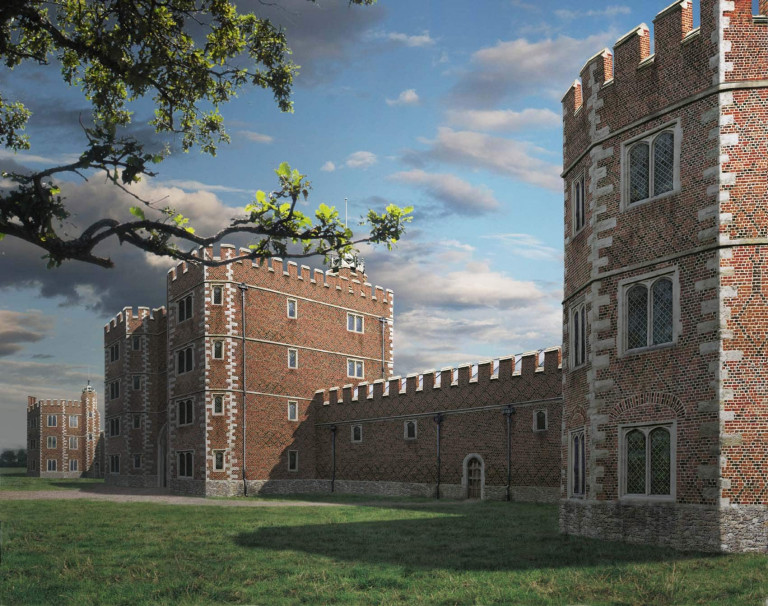
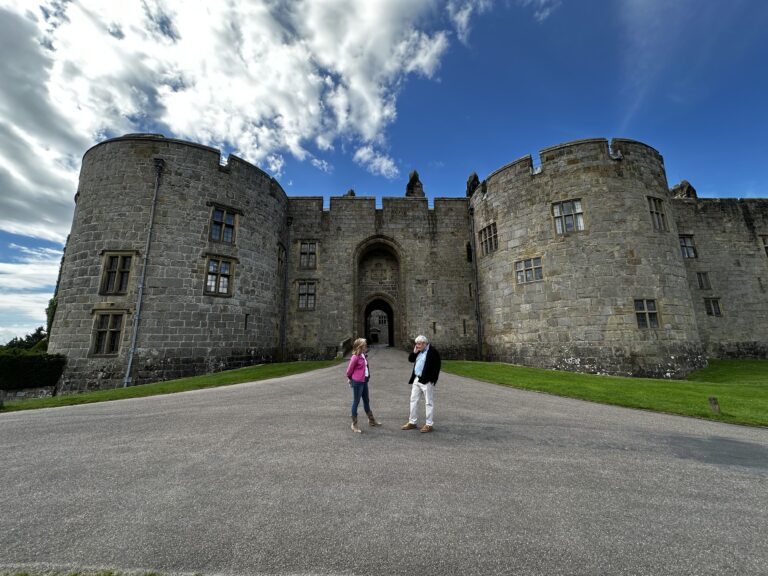
To commemorate the life of Katherine of Aragon, I’ve recorded a mini-series of podcast episodes from three places closely associated with her story: Buckden Towers, Kimbolton Castle and Peterborough Cathedral. This show notes page accompanies the final episode in this mini-series, from Peterborough Cathedral, where Katherine is buried.
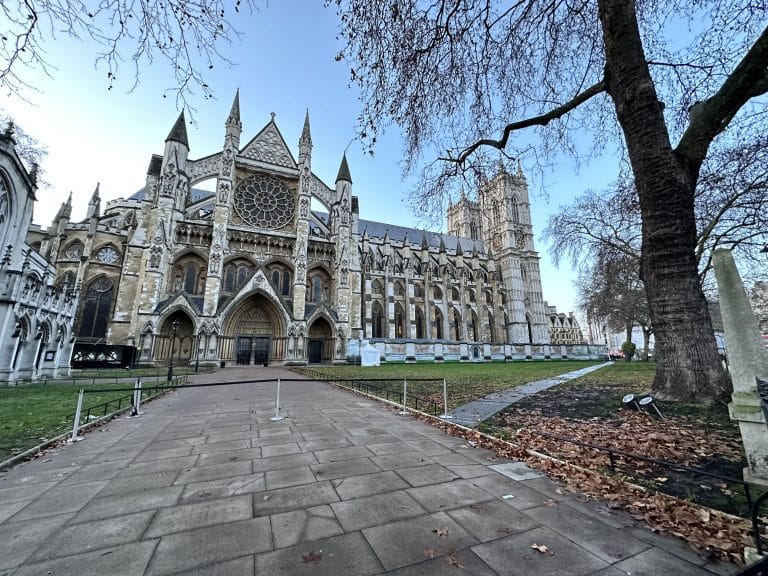
Peterborough Cathedral is among the finest Norman cathedrals in Europe, instantly recognisable by its striking west front of three vast Gothic arches. Although its story stretches back more than a thousand years to its origins as a seventh-century Anglo-Saxon monastery, the cathedral we see today was largely built during the twelfth and thirteenth centuries, in the Norman and early Gothic periods. Inside, visitors are greeted by a magnificent painted wooden ceiling, soaring stone columns and outstanding medieval artwork. Having endured wars, religious turmoil and the upheavals of the Reformation, the cathedral has remained a continuous place of worship throughout its long history.
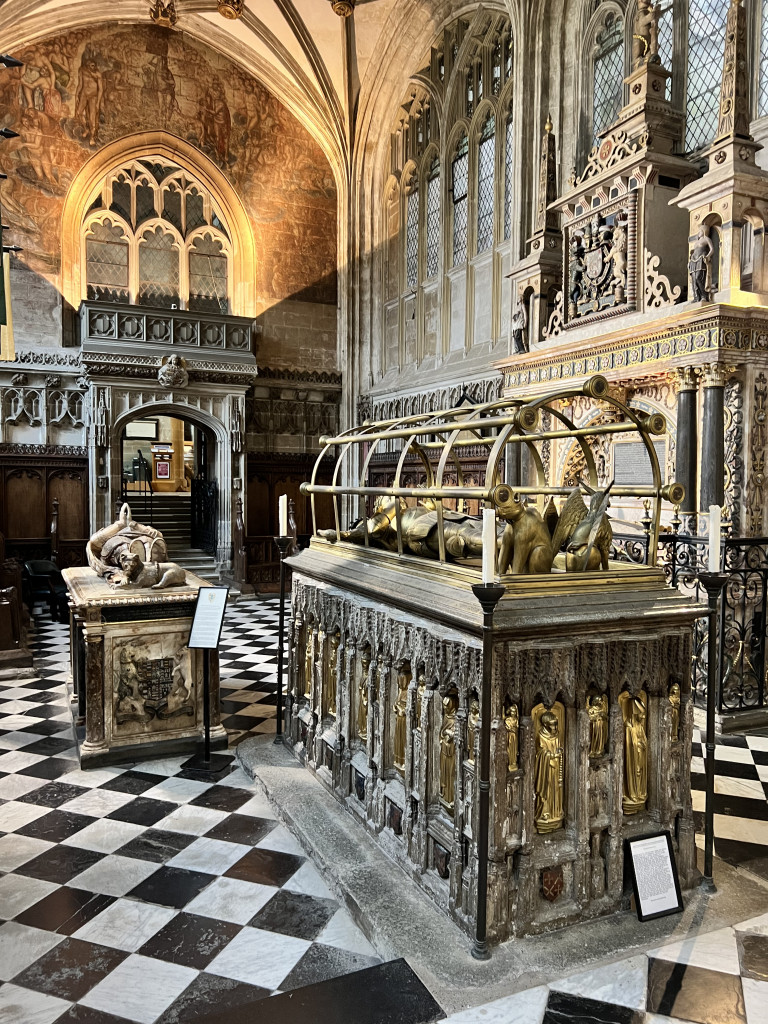
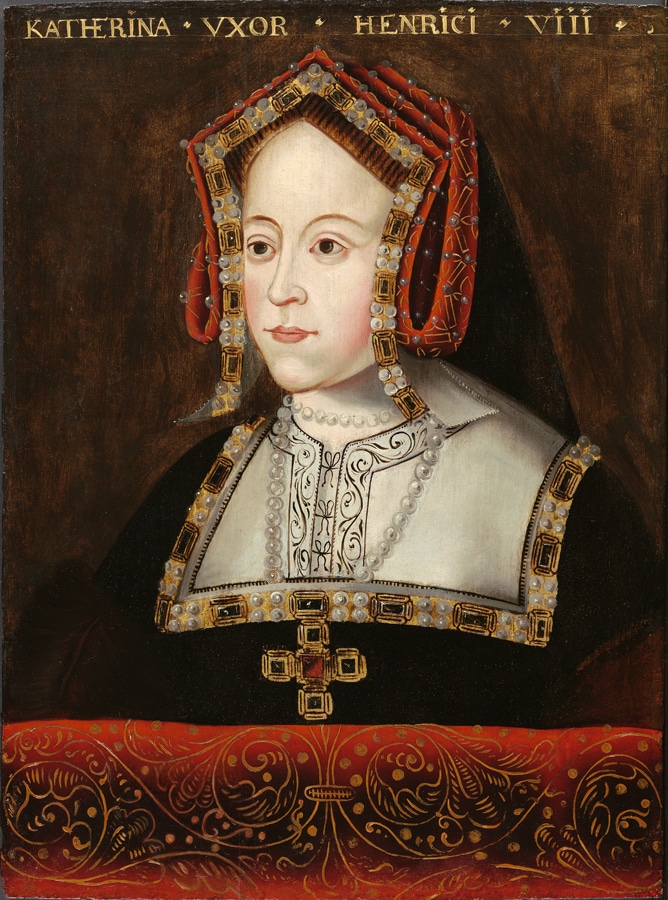
Peterborough Cathedral is also famous for its royal connections, including the grave of Katherine of Aragon. After her death at Kimbolton Castle, Henry VIII ordered a funeral that recognised Katherine not as queen, but as Dowager Princess of Wales, a title Katherine never accepted.
Despite this, her burial at Peterborough was respectful and solemn. Today, her tomb is marked by a simple stone slab in the cathedral’s north choir aisle. Peterborough remains the only English cathedral with the grave of a queen of England. Katherine is remembered there not just as Henry VIII’s discarded wife, but as a dignified, resilient woman who stood by her faith and status to the very end.
If you love contemporary accounts, read on! Below is a fascinating account from a sixteenth-century source, writing at the time of Katherine of Aragon’s burial.
Death and Burial of Katharine of Aragon
The good Queen died in a few days, of God knows what illness, on Friday 7 January 1536. Next day her body was taken into the Privy Chamber and placed under the canopy of State (sous le dhoussier et drapt destat), where it rested seven days, without any other solemnity than four flam, beaux continually burning.
During this time a leaden coffin was prepared, in which the body was enclosed on Saturday, the 15th, and borne to the chapel. The vigils of the dead were said the same day, and next day one mass and no more, without any other light than six torches of rosin. On Sunday, the 16th, the body was removed again into the Privy Chamber, where it remained till Saturday following.
Meanwhile an “estalage”, which we call a chapelle ardente, was arranged, with 56 wax candles in all, and the house hung with two breadths of the lesser frieze of the country. On Saturday, the 22nd, it was again brought to the chapel and remained until the masses of Thursday following, during which time solemn masses were said in the manner of the country, at which there assisted by turns as principals the duchess of Suffolk, the countess of Worcester, the young countess of Oxford, the countess of Surrey, and Baronesses Howard, Willoughby, Bray, and Gascon (sic).
On Tuesday following, as they were beginning mass, four banners of crimson taffeta were brought, two of which bore the arms of the Queen, one those of England, with three “lambeaulx blancs,” which they say are of prince Arthur; the fourth had the two, Spain and England, together. There were also four great golden standards. On one was painted the Trinity, on the second Our Lady, on the third St Katharine and on the fourth St. George; and by the side of these representations the said arms were depicted in the above order; and in like manner the said arms were simply, and without gilding (dourance), painted and set over all the house, and above them a simple crown, distinguished from that of the kingdom which is closed.
On Wednesday after, the robes of the Queen’s 10 ladies were completed, who had not till then made any mourning, except with kerchiefs on their heads and old robes. This day, at dinner, the countess of Surrey held state, who at the vigils after dinner was chief mourner. On Thursday, after mass, which was no less solemn than the vigils of the day before, the body was carried from the chapel and put on a waggon, to be conveyed not to one of the convents of the Observant Friars, as the Queen had desired before her death, but at the pleasure of the King, her husband, to the Benedictine Abbey of Peterborough, and they departed in the following order: First,16 priests or clergymen in surplices went on horseback, without saying a word, having a gilded laten cross borne before them; after them several gentlemen, of whom there were only two of the house, “et le demeurant estoient tous emprouvez,” and after them followed the maitre d’hotel and chamberlain, ‘with their rods of office in their hands; and, to keep them in order, went by their sides 9 or 10 heralds, with mourning hoods and wearing their coats of arms; after them followed 50 servants, of the aforesaid gentlemen, bearing torches and “batons allumes,” which lasted but a short time, and in the middle of them was drawn a waggon, upon which the body was drawn by six horses all covered with black cloth to the ground.
The said waggon was covered with black velvet in the midst of which was a great silver cross; and within, as one looked upon the corpse, was stretched a cloth of gold frieze with a cross of crimson velvet, and before and behind the said waggon stood two gentlemen ushers with mourning hoods looking into the waggon, round which the said four banners were carried by four heralds and the standards with the representations by four gentlemen. Then followed seven ladies, as chief mourners, upon hackneys, that of the first being harnessed with black velvet and the others with black cloth. After which the ladies followed the waggon of the Queen’s gentlemen; and after them, on hackneys, came nine ladies, wives of knights. Then followed the waggon of the Queen’s chambermaids; then her maids to the number of 36, and in their wake followed certain servants on horseback.
In this order the royal corpse was conducted for nine miles of the country, ie., three French leagues, as far as the abbey of Sautry, where the abbot and his monks received it and placed it under a canopy in the choir of the church, under an “estalage” prepared for it, which contained 408 candles, which burned during the vigils that day and next day at mass. Next day a solemn mass was chanted in the said abbey of Sautry, by the bishop of Ely, during which in the middle of the church 48 torches of rosin were carried by as many poor men, with mourning hoods and garments. After mass the body was borne in the same order to the abbey of Peterborough, where at the door of the church it was honorably received by the bishops of Lincoln, Ely and Rochester, the abbot of the place, and the abbots of Ramsey, Crolain (Crowland),
Tournan (Thomey), Walden (Saffron Waldon) and Thaem (Thame), who, wearing their mitres and hoods, accompanied it in procession till it was placed under the chapelle ardente which was prepared for it there, upon eight pillars of beautiful fashion and roundness, upon which were placed about 1,000 candles, both little and middle-sized, and round about the said chapel 18 banners waved, of which one bore the arms of the Emperor (Charles V), a second those of England with those of the King’s mother, prince Arthur, the queen of Portugal, sister of the deceased, Spain, Arragon, and Sicily, and those of Spain and England with three “lambeaulx,” those of John of Gaunt, duke of Lancaster, who married the daughter of Peter the Cruel, viz. “le joux des beufz,” the bundle of arrows, the pomegranate (granade ), the lion and the greyhound. Likewise there were a great number of little pennons, in which were portrayed the devices of King Ferdinand, father of the deceased, and of herself; and round about the said chapel, in great gold letters was written, as the device of the said good lady, “Humble et loyale.”
Solemn vigils were said that day, and on the morrow the three masses by three bishops: the first by the bishop of Rochester, with the abbot of Thame as deacon, and the abbot of Walden as sub-deacon; the second by the bishop of Ely, with the abbot ofTournay (Thomey) as deacon, and the abbot of Peterborough as sub-deacon; the third by the bishop of Lincoln, with the bishop of Llandaff as deacon, and that of Ely as sub-deacon; the other bishops and abbots aforesaid assisting at the said masses in their pontificals, so the ceremony was very sumptuous. The chief mourner was lady Eleanor, daughter of the duke of Suffolk and the French queen, and niece of king Henry, widower now of the said good Queen.
She was conducted to the offering by the Comptroller and Mr Gust(Gostwick), new receiver of the moneys the ~g takes from the Church. Immediately after the offering was completed the Bishop of Rochester preached the same as all the preachers of England for two years have not ceased to preach, viz., against the power of the Pope, whom they call bishop of Rome, and against the marriage of the said good Queen and the King, alleging against all truth that in the hour of death she acknowledged she had not been queen of England. I say against all truth, because at that hour she ordered a writing to be made in her name addressed to the King as her husband, and to the ambassador of the Emperor, her nephew, which she signed with these words – Katharine, queen of England – commending her ladies and servants to the favor of the said ambassador.
At the end of the mass all the mourning ladies offered in the hands of the heralds each three ells in three pieces of cloth of gold which were upon the body, and of this “accoutrements” will be made for the chapel where the annual service will be performed for her. After the mass the body was buried in a grave at the lowest step of the high altar, over which they put a simple black cloth. In this manner was celebrated the funeral of her who for 27 years has been true queen of England, whose holy soul, as every one must believe, is in eternal rest, after worldly misery borne by her with such patience that there is little need to pray God for her; to whom, nevertheless, we ought incessantly to address prayers for the weal (salut) of her living image whom she has left to us, the most virtuous Princess her daughter, that He may comfort her in her great and infinite adversities, and give her a husband to his pleasure.
Notes: The original is in French, in the Vienna Archives of Charles V. “Estalage” means “display”, “lambeaulx” means “strips”, “et le demeurant estoient tous emprouvez” means” and the rest were all borrowed”, ie. stand-ins. The Bishop of Llandaff was George Athequa, a Spaniard who had ministered to Katharine.
During this episode, I’m accompanied on-location by Reverend Canon Tim Alban Jones, Vice Dean and Canon Precentor. Join us as we explore this exquisite building. Please also find below a gallery of images from my on-location visit. You can listen to the podcast episode here or by clicking the button below:
Listen to the podcast
Peterborough Cathedral Image Gallery
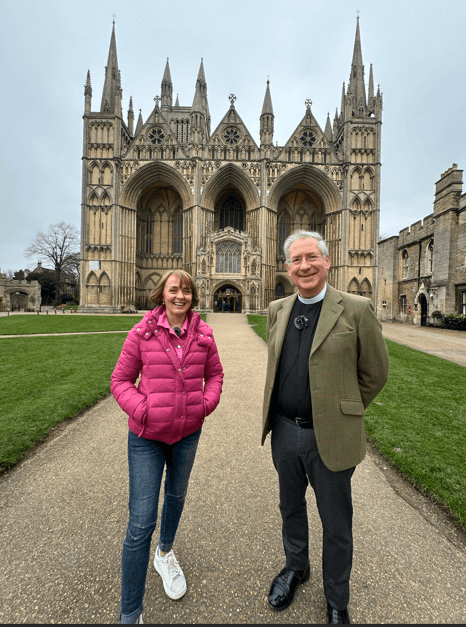
Image © The Tudor Travel Guide.
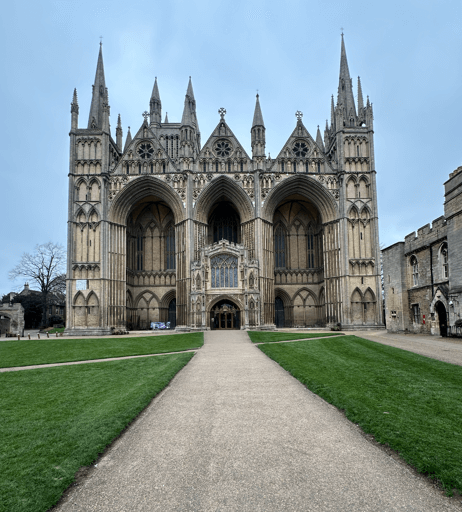
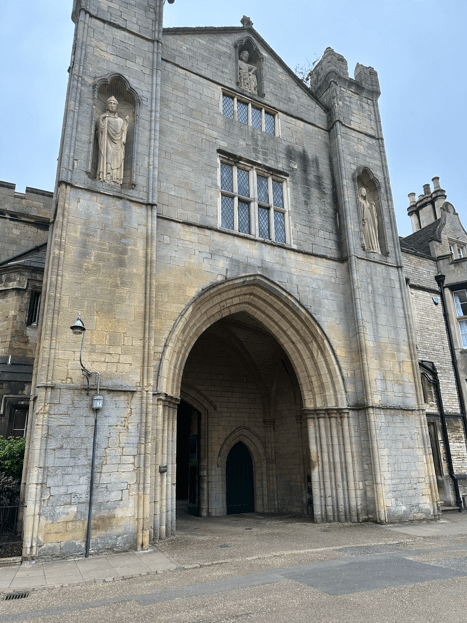
The West Front (left) and the main entrance to the old abbott’s lodgings (right).
Images © The Tudor Travel Guide.
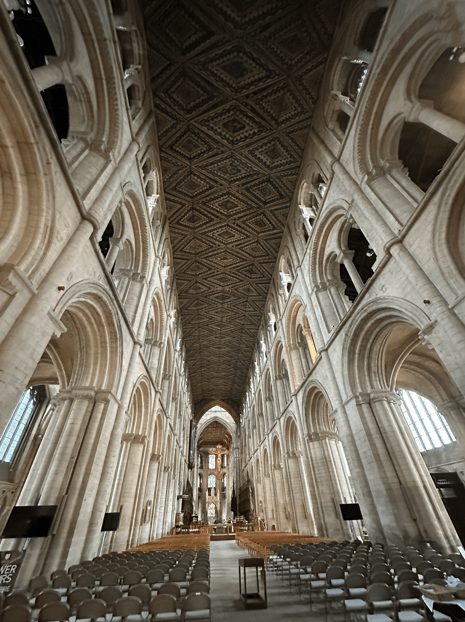
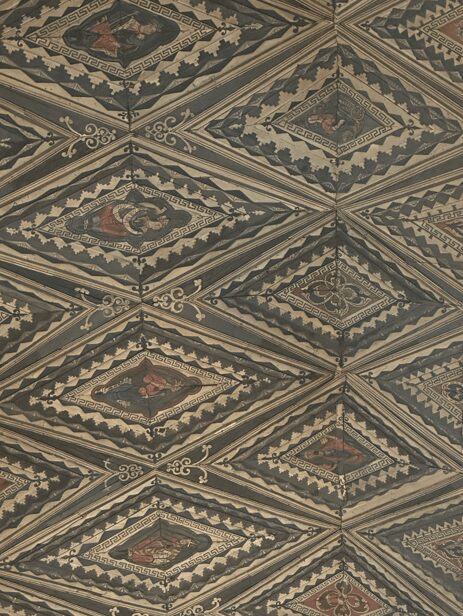
The nave and a close-up of the nave ceiling.
Images © The Tudor Travel Guide.
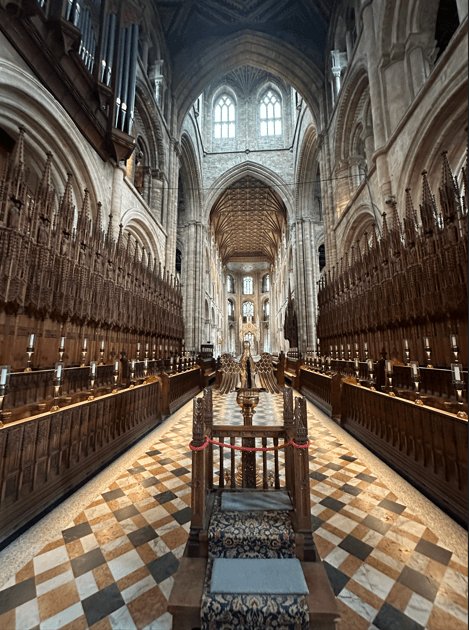
Image © The Tudor Travel Guide.
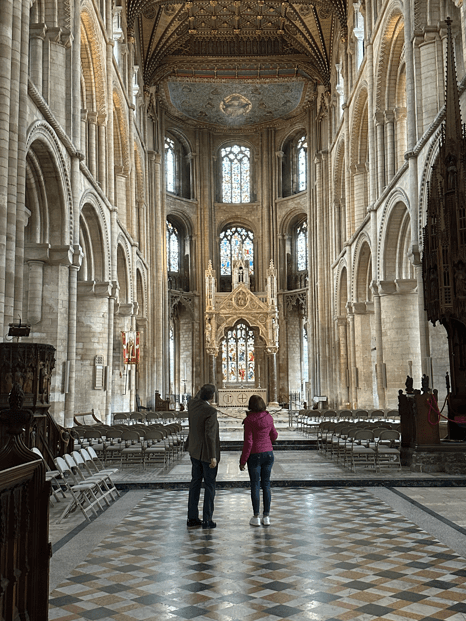
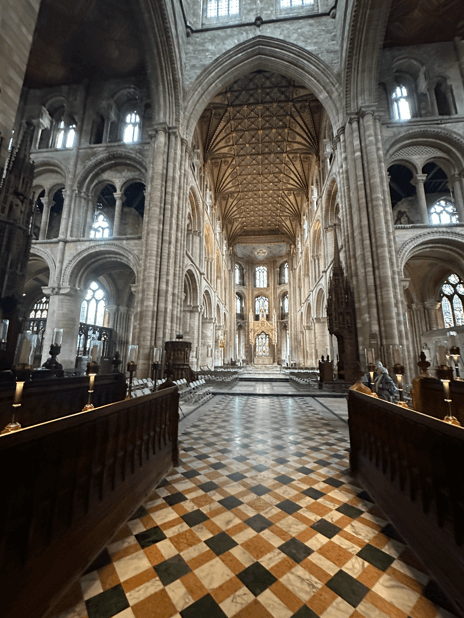
Inside Peterborough Cathedral, looking towards the high altar.
Images © The Tudor Travel Guide.
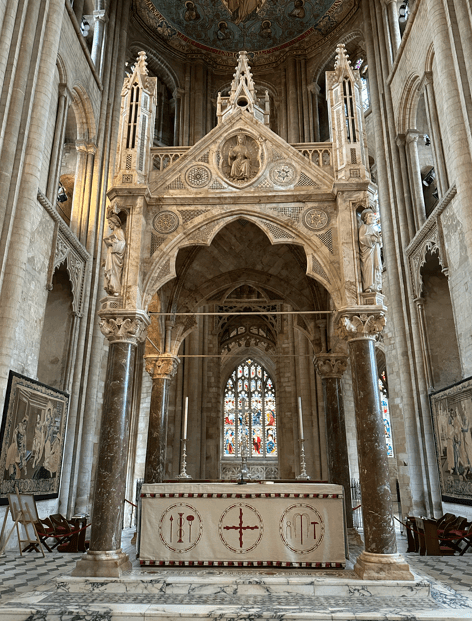
The high altar, Peterborough Cathedral.
Image © The Tudor Travel Guide.
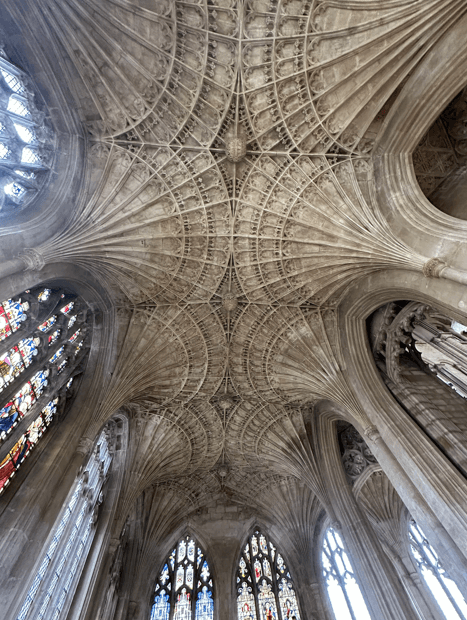
Image © The Tudor Travel Guide.
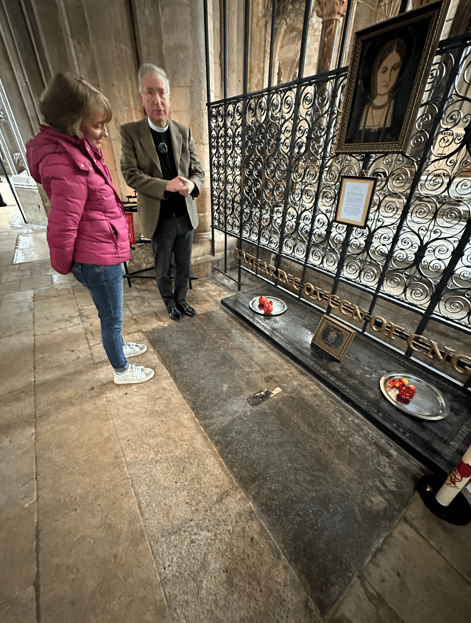
Image © The Tudor Travel Guide.
Useful Links
Visiting information for Peterborough Cathedral is here.
This podcast episode is the final in a three-part series commemorating Katherine of Aragon. The first and second podcast episodes and their accompanying show notes pages are linked below:
- Buckden Towers: Show notes page with image gallery is here, and podcast episode is here
- Kimbolton Castle: Show notes page with image gallery is here, and podcast episode is here
If you have a few days in the area, the following places might be of interest to you:
- Peterborough Museum & Art Gallery – Queens, Cousins & Courts Exhibition (runs until 28 February 2026)
- Burghley House (12 miles)
- Lyveden New Bield (22 miles)
- Kimbolton Castle (accessible via private tour or open day) (25 miles)
- A suggested itinerary for a day out in Cambridge is here (42 miles)
- Fotheringhay Castle site (15 miles) – my blog about this site is here, and my on-location video is here.
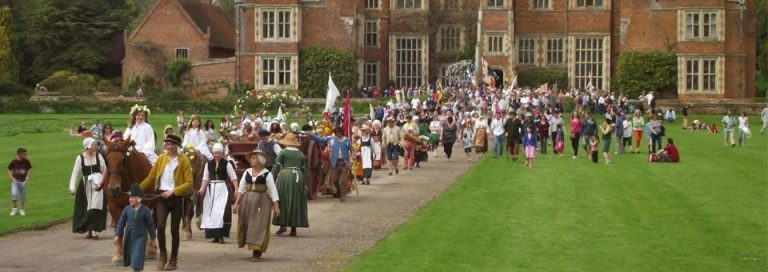
Each year, a Katherine of Aragon Festival takes place in late January. Information about the 2026 festival can be found here. This year’s event is now drawing to a close – keep an eye out for details of the 2027 festival, which will be announced in due course.