‘Notes From Anne Boleyn’ by Geoff Proudley
In this guest blog, I’m delighted to introduce you to Geoff Proudley and find out more about his latest album. Geoff shares the inspiration behind the album, the stories and ideas that shaped it, and offers insight into the creative process behind his latest work. Read on to discover more about Geoff, his music, and the journey behind this new release.
An Introduction to ‘Notes From Anne Boleyn’
May 2026 saw the release of a new album from English composer Geoff Proudley entitled ‘Notes from Anne Boleyn’. This musical narrative marks the 490th anniversary of the execution of Henry VIII’s second, and perhaps most notorious, wife.
The album paints Anne’s life in music from her family’s move to Hever Castle in 1505 through to her tragic end on Tower Green in May 1536. Written as a series of diary entries in the accompanying booklet, the album takes you on an immersive musical journey, examining her feelings and experiences as she rose from attending European royalty as a young girl to becoming Queen of England herself. Then, as her fortunes change, we follow her painful demise and tragic fall from grace.
The album follows on from Geoff’s 2022 project ‘K of A’ about the life of Katharine of Aragon. Using a similar sound palette of piano, harpsichord, dulcimer, Tudor percussion, and instruments such as lute, crumhorn, and viols with additional sound design elements, Geoff paints a musical picture of the events of Anne’s life as it unfolds.
Notes From Anne Boleyn: Q & A With Geoff
Did you always plan a follow-up to ‘K of A’?
No! I did say I wouldn’t do another one after ‘K of A’. However, this story wouldn’t leave me alone. I just kept imagining scenes from Anne’s life and writing more and more pieces. I find I can place myself in someone’s position and really start to think about how they might have felt. Somehow, this comes through in the music I write. It’s a curious thing. It was important to capture the early pieces and ideas. Sometimes it was just a phrase, other times a piece came fully formed. But gradually, saving and developing them, I found I was piecing together her life.
I’d get ideas late at night and stay up into the small hours to sketch them out. I guess there was a critical mass of about six or seven pieces when I knew I could do an album. Importantly (and this is something I did with ‘K of A’), I constructed a timeline on the studio wall and gradually populated it with notes. That way, I could see what I’d done and where I was missing any key pieces. Clearly, there is a chronology to the pieces that must be followed. You also have to pick which events you are going to write about. This album is more concise, about half the length of ‘K of A ’, running
in at about forty minutes. In a way that reflects the much longer period of time that Henry was married to Katharine.
How did you develop the Album artwork?
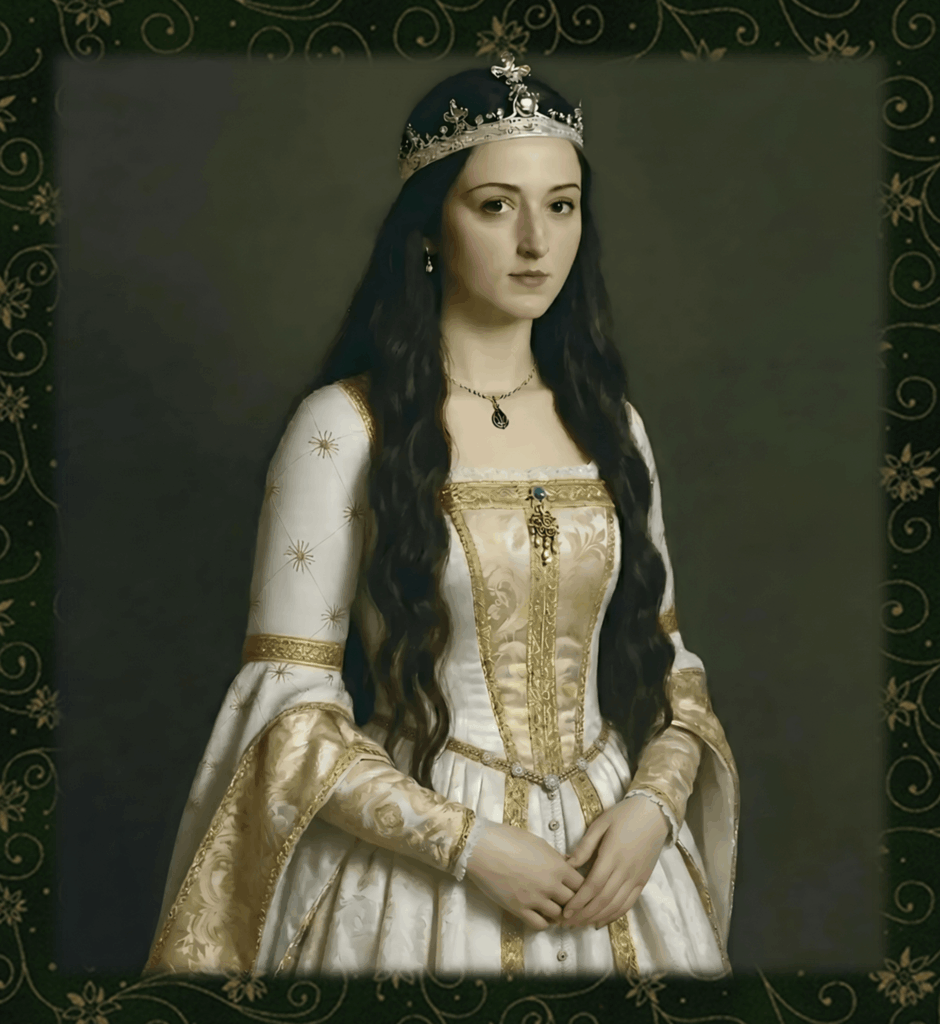
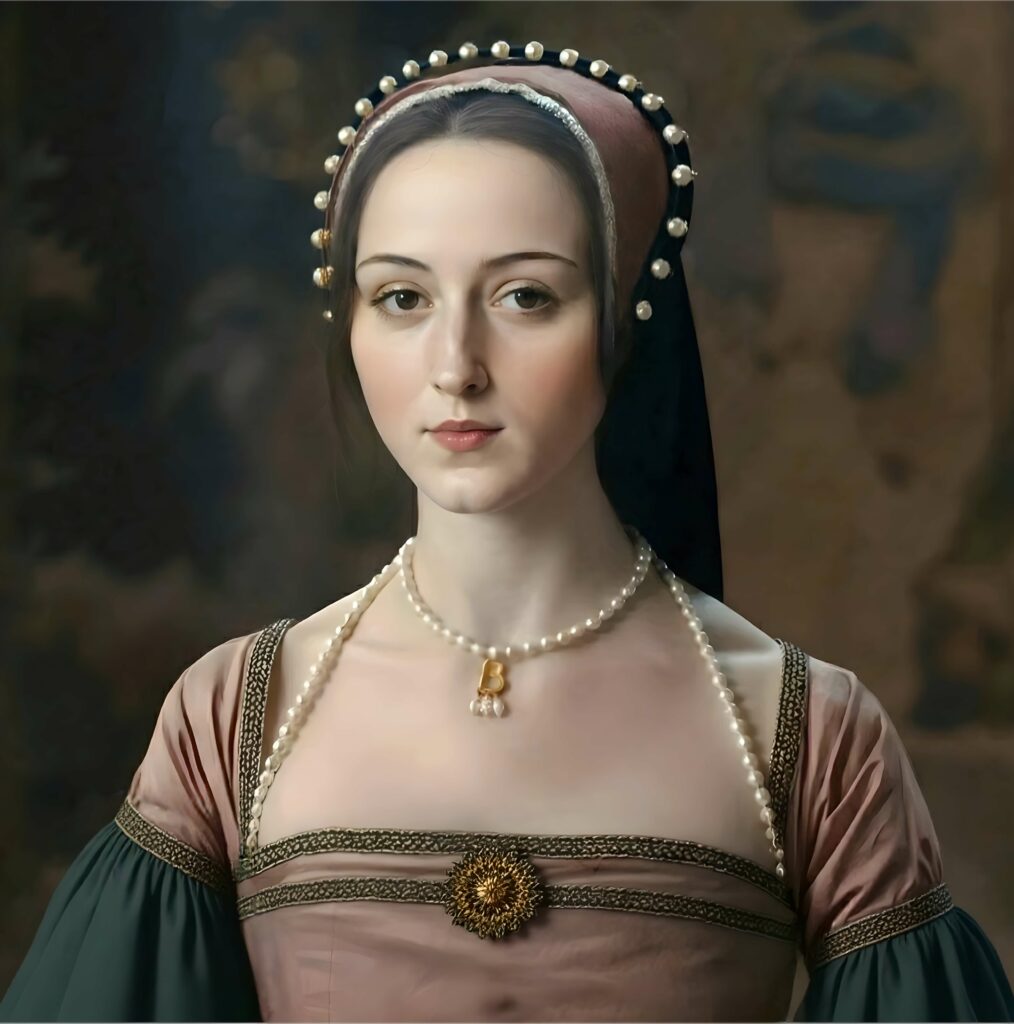
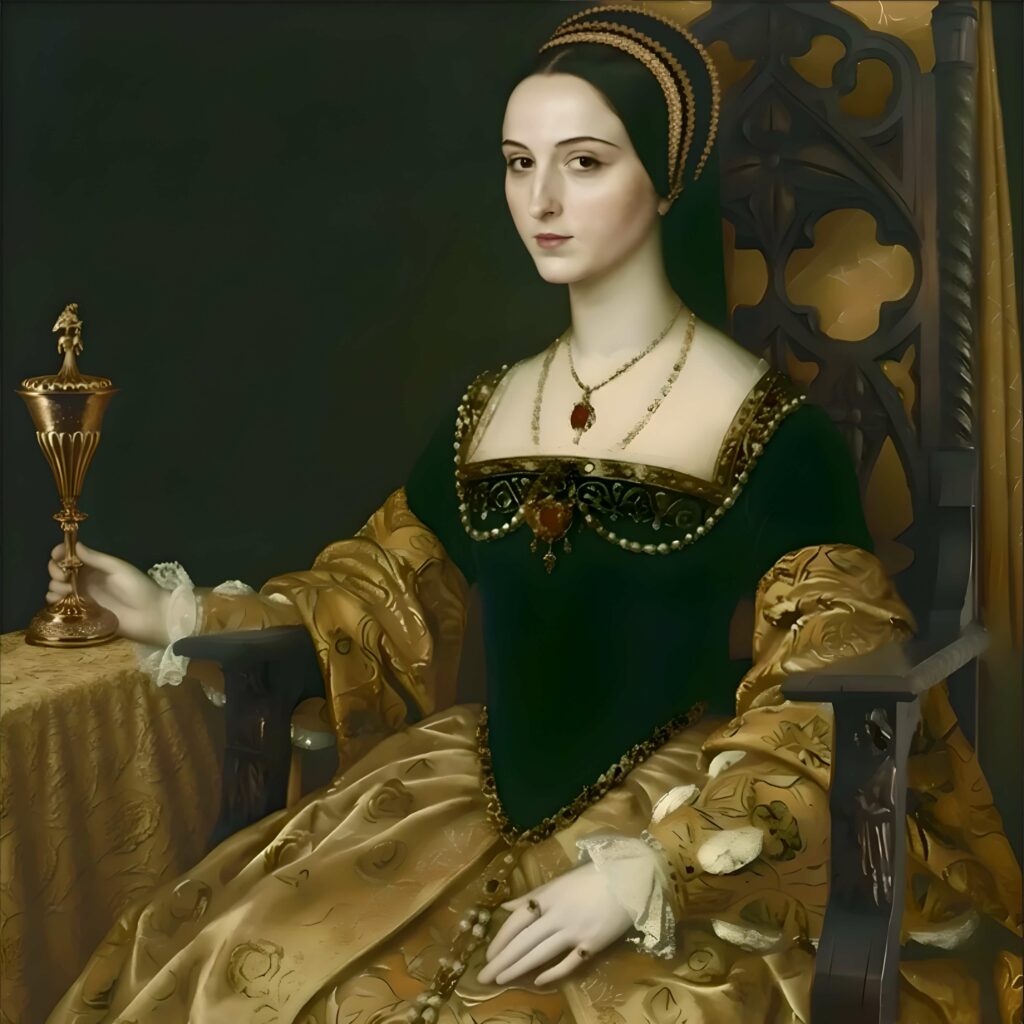
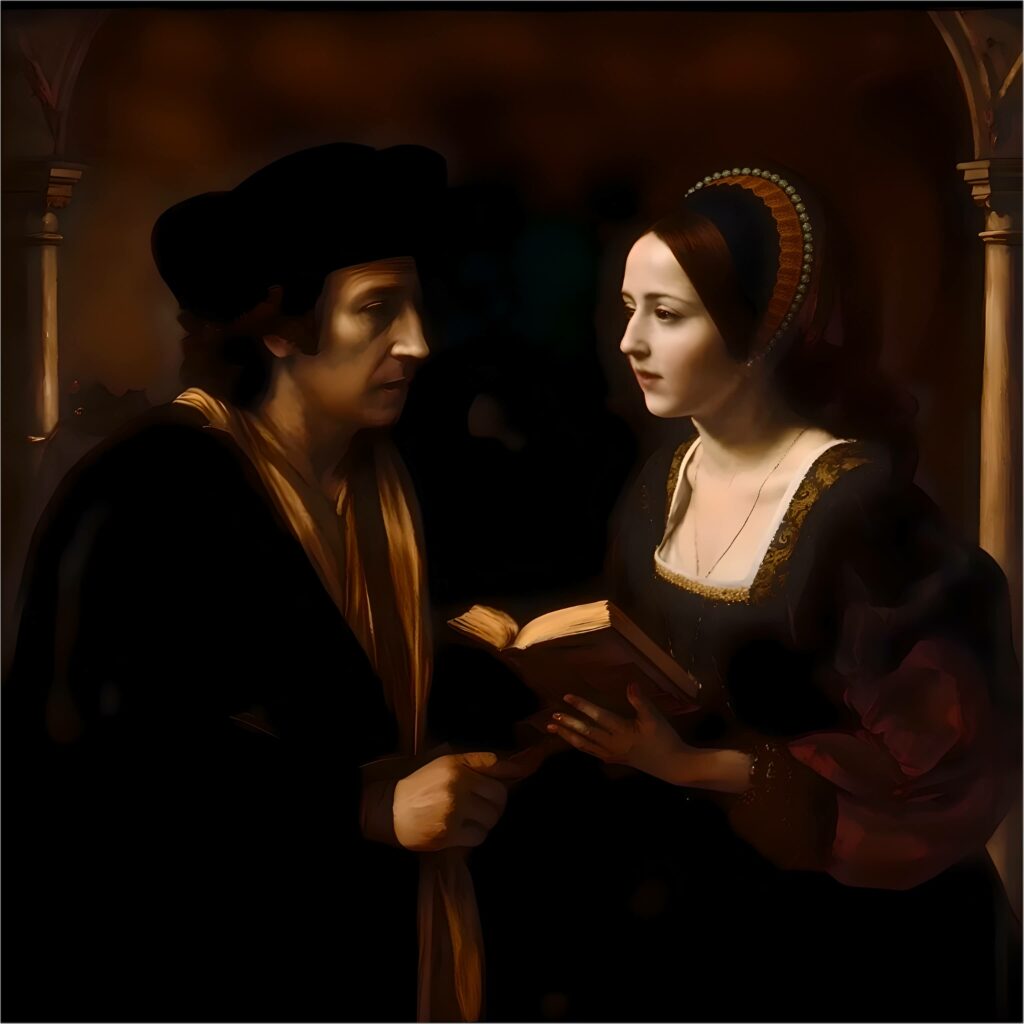
I never start thinking about artwork until I’m sure I have enough material. Once I reach that point, I start to think about possible illustrations, style, and packaging. I settled on a similar CD matchbox package like the ‘K of A’ album. I just thought it would be nice to have them in similar packaging to complement each other. It also made the decision on lettering easier. I see the albums as a complementary pair. The artwork probably took about six months to develop, as I was finalizing the arrangements and edits for the music. I should say the artwork was reviewed and finessed extensively to try and get a consistent set of images that would complement the music. I think I formulated about 2,000 images to arrive at the final set.
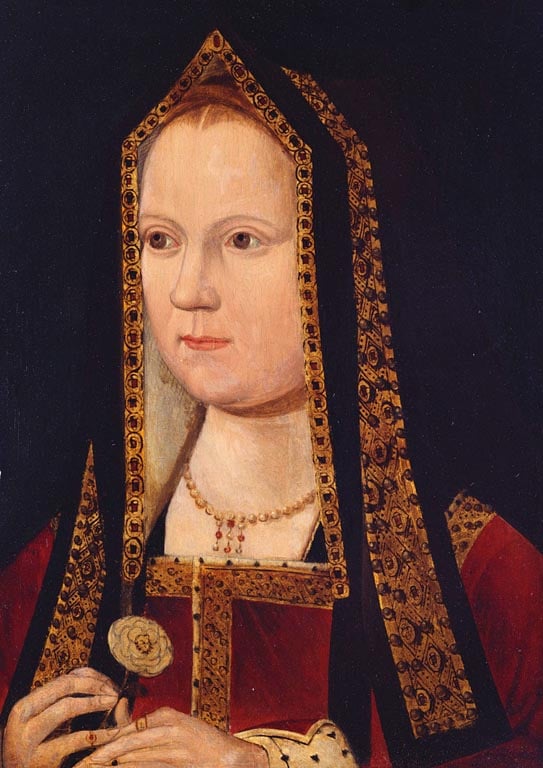
There’s also the issue of Anne’s image. We don’t actually know what Anne Boleyn looked like. There are few contemporary images of Anne, and even questions and uncertainties over those we do have. Later copies of paintings exist with potential bias to the image or creative editing, further fueling the uncertainty. I took the National Portrait Gallery image of Anne as a basic start point and created scenes
from her life from that. It was an image I was familiar with and, importantly, one I was happy to work with. In my mind, it’s close to how I imagine she may have looked.
As I got further down the line, I also engaged Professor Maria Hayward from Southampton University to review the imagery. This was both invaluable and interesting for me. It helped to get some historical accuracy to the dress and clothing in the illustrations, although I also liked to chance some ideas. I think Anne was very much a fashion leader, and who knows, maybe some of the outfits she wore were unique. It’s a shame that so much evidence was erased or destroyed after Anne’s downfall. But that’s really why this period is so interesting to explore. It’s the absence of actual images that allows us to explore and create them in our own minds. We can fill in the blanks. The imagery here is my interpretation, taking some pointers from the historical record.
What is your opinion of Anne having completed this project?
When I wrote about Katharine, I viewed Anne as a kind of villain who was instrumental in her downfall. Some of that persists; however, this project gave me the chance to see things from her side, examine her feelings and ambitions, loves, sense of duty, hopes and dreams, fears, and sadness. Ultimately, I don’t see Katharine and Anne as being that different. They shared common traits: a tragic downfall and the failure to provide Henry with a male heir. Plus, both their daughters would eventually rule England, which seemed unlikely when they were born.
There were other actors who controlled both their fates and both were victims of them. There are also real human emotions in her story that are common to us all, even today, and rich for musical exploration. So, the sense of love and loss, pride and ambition, disappointment, hope, worry and fear, they’re all here in ‘Notes from Anne Boleyn’.
Which tracks were you most pleased with?
La Petite Boulain – A delicate piece inspired on dulcimer that somehow always makes me think of Anne as a young girl learning the art of court etiquette in Europe. It has an innocence about it that I like. The melody is fragile.
Masque Dance – This turned out exactly how I imagined it in my head. I wanted to write a piece that projected one of the main themes I use throughout the album, while also bringing out the intrigue and flirtation of the Tudor Masque. I had in my head this vision of Anne and Henry dancing at court, identities masked, the crowd of onlookers clapping them in their gamely pursuit. Engineering-wise, I recorded loads of multitrack hand claps over and over again to build up the scene and lock into a harpsichord vamp. The crumhorn also adds a nice figure throughout until the main theme bursts onto the scene again in a final climax.
We Shall Have Sons – A piece that just fell from the sky as I imagined Anne desperately praying for a son to save herself and her marriage. Sometimes music just happens; in a moment, it is created, and moments earlier, it didn’t exist. This piece genuinely moved me and said just what I needed to say. I wrote it in the time it took to play.
Traitors’ Gate (Barge to Tower) – This is probably the most interesting piece from a musical production point of view. It describes Anne’s progress from Greenwich to the Tower of London by barge after being accused of treason. I was playing around with some sound effects late at night, notably rowing sounds, and realized there was a natural rhythm to the oar strokes. Slowing them down slightly, finessing the interval to create a time signature I could work to, and adding a string figure on top instantly created this
drama and tension. I could see Anne being taken by barge to her prison. Imagining what was going through her head on that river trip. It must have been so confusing for her. Along the river she loved, her head full of worry, she must have wished the waves would swallow her up.
Caged – Music takes many forms, and I like to use unlikely elements to create it. Here, a simple bird song is accompanied by a doleful recorder. The mood it created was so interesting to me. It immediately made me think of Anne seeing a songbird from her prison window and recalling a bird she had kept in a cage as a child. Now the roles were reversed. She was the one who was caged.
Procession – From a sound-design standpoint, this piece offers an interesting perspective. It’s basically a crowd’s-eye view of Anne’s procession to be crowned Queen in 1533. Based on a fanfare theme, the crowd plays a big part in this one. I wanted to capture a mix of the atmosphere among those genuinely supportive of Anne and those who were still staunch supporters of Katharine. I should probably give a shout-out to ‘A New Order’ as it was the first theme I wrote for this project. It formed one of the recurring themes of the album. The measure of it suggested Anne and Henry processing into court, her ladies and household in train. Just after she was made Queen.
What formats will the album be available in?
Well, initially, as a CD release with a 52-page booklet but also as a digital download. This will be available through my website here. Other download sites you can find it on include Fidbak and Bandcamp (16-bit initially, with 24-bit to follow for any audiophiles out there!).
Will there be another follow-up – Jane Seymour springs to mind?
Absolutely, definitely, possibly not! I think Katharine and Anne’s stories were so intertwined that they were ideal for writing a musical narrative. Indeed, now that I’ve finished Anne’s album, the two works seem to complement each other well. Honestly, I’m sure that’s it, but then I said that after ‘K of A’
Full Track List
- From Blickling to Hever
- We Three Boleyn
- La Petite Boulain
- Learning Grounds
- The Earl of Ormond
- My Lord Percy
- An Injured Heart
- Masque Dance
- The Lady Anne
- Riding Out to Hever
- Patience Will Be My Song
- Calais (The Unveiling)
- Procession
- A New Order
- Elizabeth
- A Tour Christmas
- We Shall Have Sons
- Still I Will Prevail
- Accused
- Traitors Gate
- Caged
- All This For Such A Little Neck
- I Am Come Hither To Die
‘Notes From Anne Boleyn’: Useful Links
You can buy a copy of Notes From Anne Boleyn here.
Notes From Anne Boleyn may eventually appear on general streaming sites, but that will be further in the future. For now, you can access the album as follows:
About Geoff Proudley
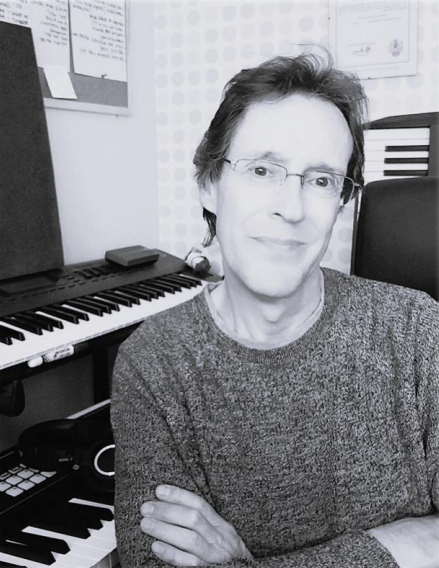
Geoff Proudley is an English composer, songwriter & keyboard player. With foundations rooted in an emotive English sound, Geoff’s principal instrument is the piano. Early classical training together with his own idiosyncrasies combine to produce an interesting technique and approach to music. He likes melody, structure, unusual chords, and combinations of instruments. ‘Sometimes things that shouldn’t work do; you just have to be brave enough to try them.’ Much of Geoff’s work sits in the progressive rock genre, but he is equally happy to write for media, radio and television. He describes his writing as creating musical ‘postcards’. These often lend themselves to the discipline of Library and Production Music. His keen interest in Tudor history has resulted in the creation of two musical narrative albums, ‘K of A’ and ‘Notes from Anne Boleyn’.
You can visit Geoff’s website here, contact him at info@geoffproudley.co.uk