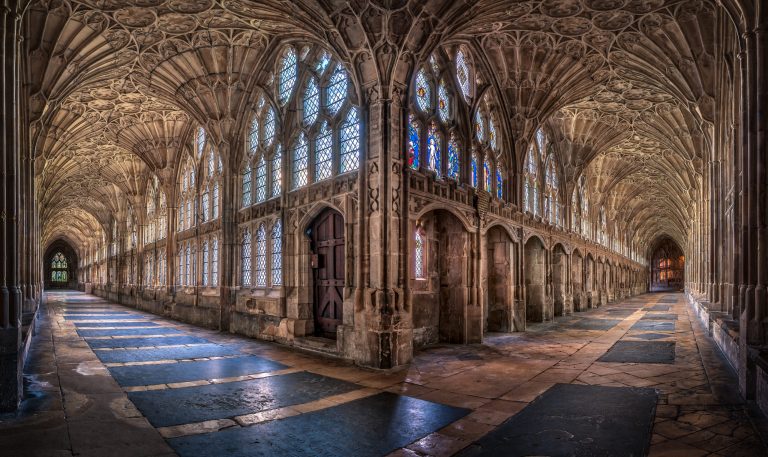
Tudor Gloucester: Gateway to the West and Crossroads of Kings
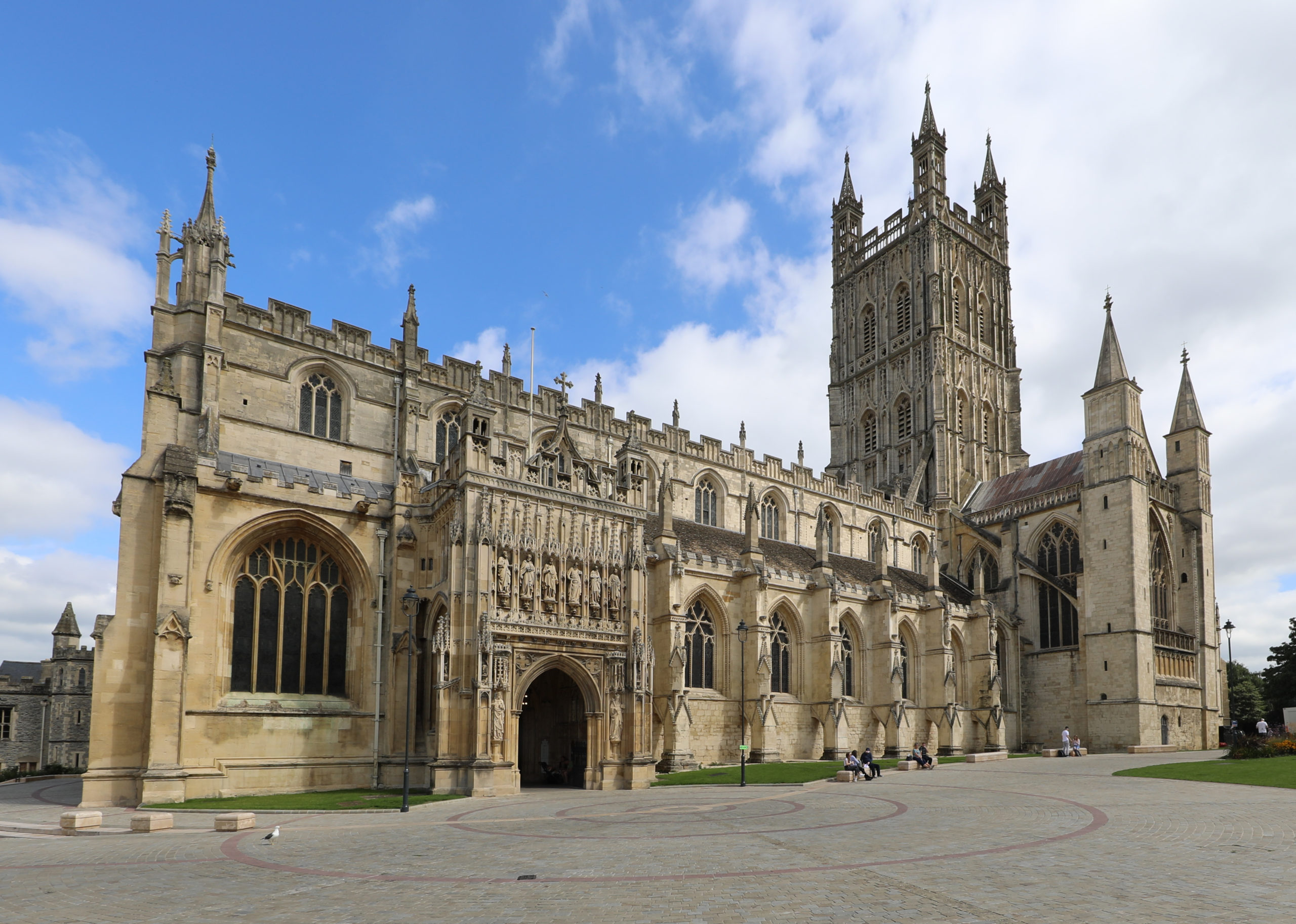
Gloucester is a city steeped in history. Nestled 19 miles from the Welsh border and straddling the Roman Ermin Street, it has variously been known as ‘The Gateway to the West’ or ‘The Crossroads of Kings’. However, in its medieval and Tudor heyday, it was far more.
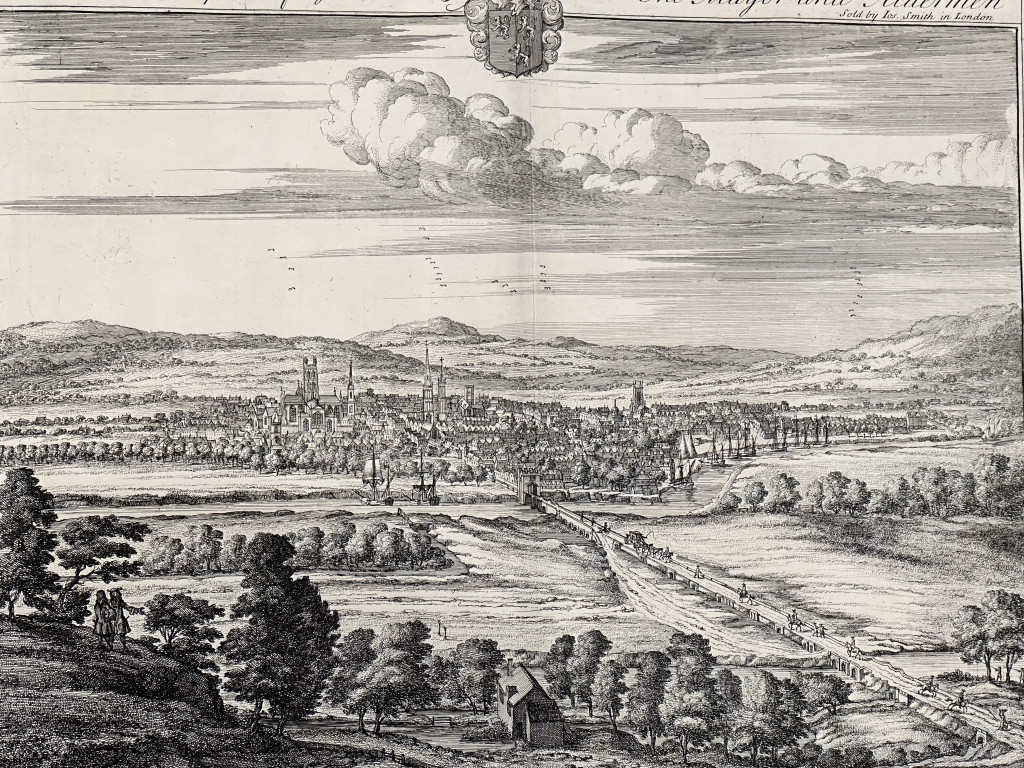
Before its Georgian decline, when fashionable Cheltenham began to eclipse its neighbour, Gloucester rivalled London and Westminster in importance. It was a political powerhouse: kings convened here, councils gathered, and parliaments were held. Though later redevelopment has erased many of its medieval and Tudor buildings, glimpses of its grandeur remain, scattered like breadcrumbs through the historic cityscape.
Today, those remnants still call to the curious traveller. Gloucester Cathedral soars over the city, while Tudor-era inns and timber-framed houses stand proudly among their modern neighbours. These surviving fragments are more than enough to spend a day immersed in the city’s story—walking in the footsteps of monarchs, martyrs, and merchants alike.
In this edition, I invite you to journey through Gloucester’s medieval and Tudor past—to wander the cloisters, linger at forgotten priory walls, and trace the echoes of a city that once stood shoulder to shoulder with England’s greatest.
Itinerary
- Gloucester Cathedral
- Blackfriars
- Llanthony Priory
An Introduction to Tudor Gloucester
The Foundations of Royal Prestige
Following the foundation of a Roman town in the first century AD, Gloucester’s significance became established. The Anglo-Saxons built a Royal Palace at nearby Kingsholm. It was used regularly by Edward the Confessor, one of the last Saxon Kings of England, as a regular meeting place for the King and Council. This tradition was adopted by his Norman successor, William the Conqueror. Maintaining this focus on royal power served to elevate Gloucester to the same status as the two other great cities of medieval England: London and Winchester.
The city reached its zenith during the medieval period, facilitated in part by its proximity to the English-Welsh border and the presence of the River Severn. The depth of the river made Gloucester the furthest inland port in England, allowing direct access to the sea for large sailing ships. As a result, trade flourished with the export of some of Europe’s finest wool, produced in the nearby Cotswolds, while raw materials such as iron and timber were also plentiful.
A Medieval Powerhouse
Medieval monarchs who spent a considerable amount of time in the city included Henry III, Edward I, Henry IV, and Henry V. Indeed, the former was crowned in the Abbey of St Peter (now Gloucester Cathedral) in 1216, at the age of nine. In fact, the coronation of Henry III remains the only one of a post-conquest monarch to take place outside Westminster Abbey.
Gloucester was also a site of pilgrimage, with pilgrims flocking to the city in their thousands to venerate the tombs of an Anglo-Saxon saint, whose relics were housed in the church of St Oswald, and a much-loved medieval king. Of St Oswold’s, only a few fragments of the church remain standing above ground. However, it is a different story for the aforementioned king. The monarch in question is Edward II. He infamously met a violent end at nearby Berkeley Castle in 1327, and his remains now lie entombed in an exquisite monument located in Gloucester’s current cathedral.
Roll forward around 150 years, when the Wars of the Roses, a war that tore England’s aristocracy apart in the mid-fifteenth century, arrived at the gates of the city. The Lancastrian army, spearheaded by the formidable Margaret of Anjou, was barred from passing through Gloucester on her way to unite with their allies in Wales. In contrast, Edward IV was later granted entry, passing through the town with his troops en route to the decisive Battle of Tewkesbury. This battle would ultimately bring an end to the House of Lancaster, leaving the Yorks to reign supreme – at least for the time being!
Tudor Threads Woven Through the City
Another battle touched the city’s history some fifteen years later. In 1485, the town offered refuge to those fleeing the Battle of Bosworth, including three leading Yorkist noblemen: Francis, Viscount Lovell; Lord Humphrey Stafford and his brother, Thomas. They sought sanctuary in St John’s Church, on Northgate. Part of this fourteenth-century church still stands in the shape of its tower and steeple, although it is hidden behind later Georgian and Victorian ‘improvements’.
The victor of Bosworth and founder of the new Tudor dynasty, Henry VII, came to Gloucester on several occasions during his reign. Henry took every opportunity to reinforce his claim to the English Crown by assiduously following the traditions of his predecessors. This may explain the reason for his visits. However, we should not overlook the fact that Henry was a prudent king with a keen eye for good fiscal governance. Examining the itinerary of his 1502 progress reveals that the King used his travels through Gloucestershire to consolidate connections with wealthy Cotswold wool merchants, whose deep pockets often financed the Crown. These travels brought him into the vicinity of Gloucestershire’s county capital.
Such visits also allowed the King to catch up and conduct business with old friends, such as the Prior of Llantony Priory, Henry Dene. Dene eventually became the King’s Archbishop of Canterbury, presiding over the marriage ceremony of Prince Arthur to Katherine of Aragon in November 1501. Tragically for his parents, Arthur died suddenly at Ludlow Castle in April of the following year. This left Henry VII and Elizabeth of York consumed with grief and seeking solace in a summer progress to Henry’s erstwhile childhood home, Raglan Castle. The couple passed through Gloucester along the way, staying at The Over, one of the Bishop’s hunting lodges lying just to the west of the city.
Around thirty years would lapse before the city welcomed another Tudor monarch. This time, it was Henry VIII who arrived at Gloucester in 1535 with Anne Boleyn at his side. It would be Anne’s last summer progress, and records from the Corporation of Gloucester provide a tantalising, detailed insight into the everyday rhythm of the Tudor court on progress. If you wish to read more about this week spent idling away the summer amidst the lush Cotswold countryside, you can do so by reading my co-authored book, In the Footsteps of Anne Boleyn.
Neither Edward VI nor Mary I are known to have visited the city; however, the latter’s ascendancy to the Crown was announced from the galleries of The New Inn (built circa 1450), in the presence of a large retinue of yeomen, gentlemen and knights, all of whom had flocked to Gloucester to hear the historic proclamation. However, in contrast, Elizabeth I, the final Tudor monarch, graced the city with her presence on three occasions: during the summer progresses of 1574, 1580, and 1592; the latter was while she was staying at nearby Sudeley Castle.
For the remainder of this article, I’ll focus on some of the most notable locations in Gloucester with links to Tudor history.
Itinerary
Gloucester Cathedral: A Living Monument
During the Tudor period, Gloucester was a walled city accessed from four points of the compass by its medieval gates. A broad high street (whose footprint still exists today) ran east-west through the centre of the town, off which was King Edward’s Gate, the principal gateway to the great Abbey of St Peter (now ‘Gloucester Cathedral’).
Without a doubt, the cathedral was, and remains, the glittering jewel of Gloucester’s heritage landscape. The glorious eleventh-century building, which, like many English cathedrals, began life as an abbey church, housed a religious order of Benedictine monks. They oversaw the gentle rhythm of religious observance, punctuated by moments of national spectacle and drama, including the aforementioned coronation of Henry III as a boy-king and the internment of the murdered Edward II in 1327.
Frustratingly, there is no record of Henry VII or his Queen Consort, Elizabeth of York, coming to the Cathedral during their sojourns to Gloucester. However, it is hard to imagine they did not visit or hear Mass at the most significant religious house in the city.
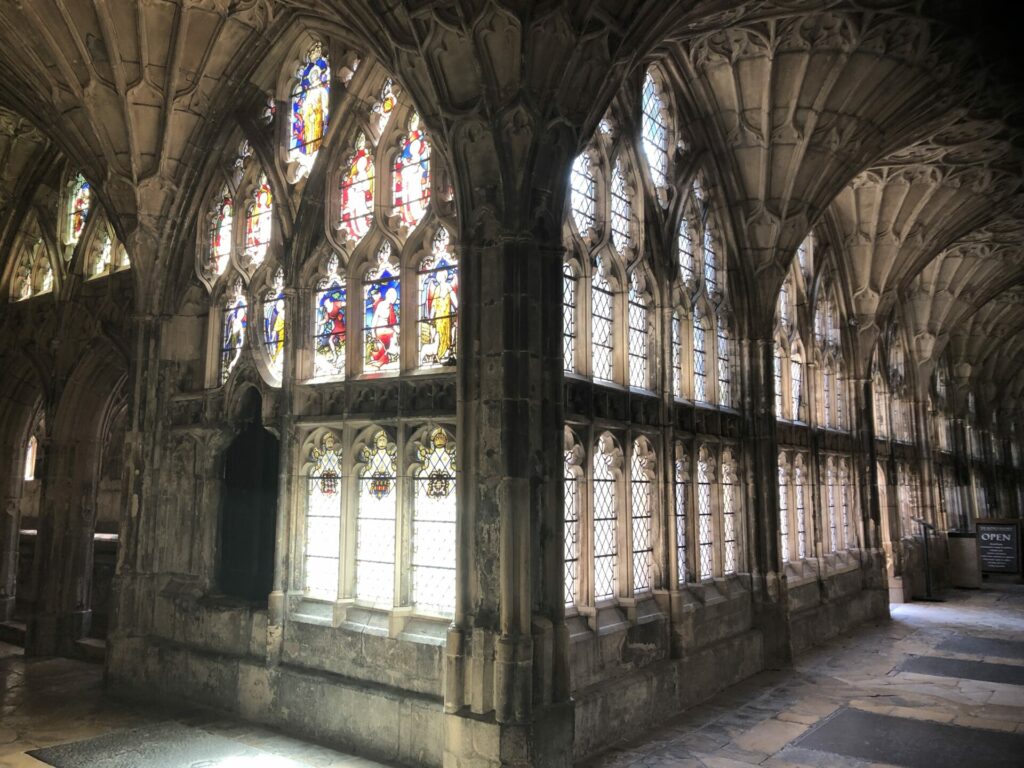
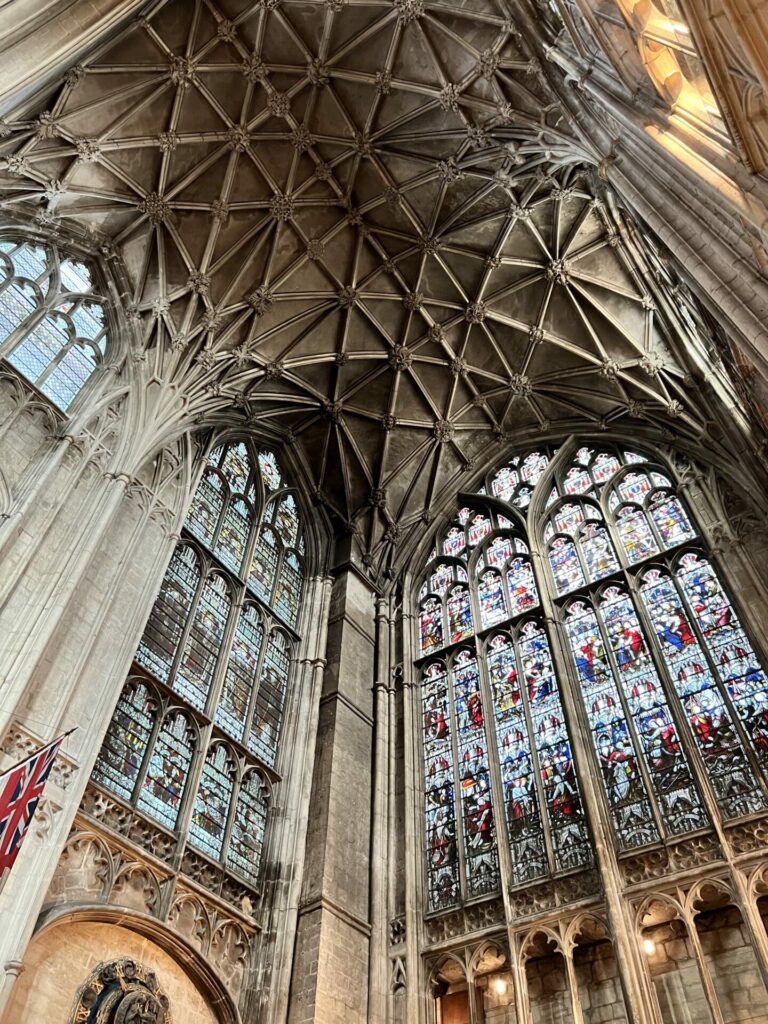
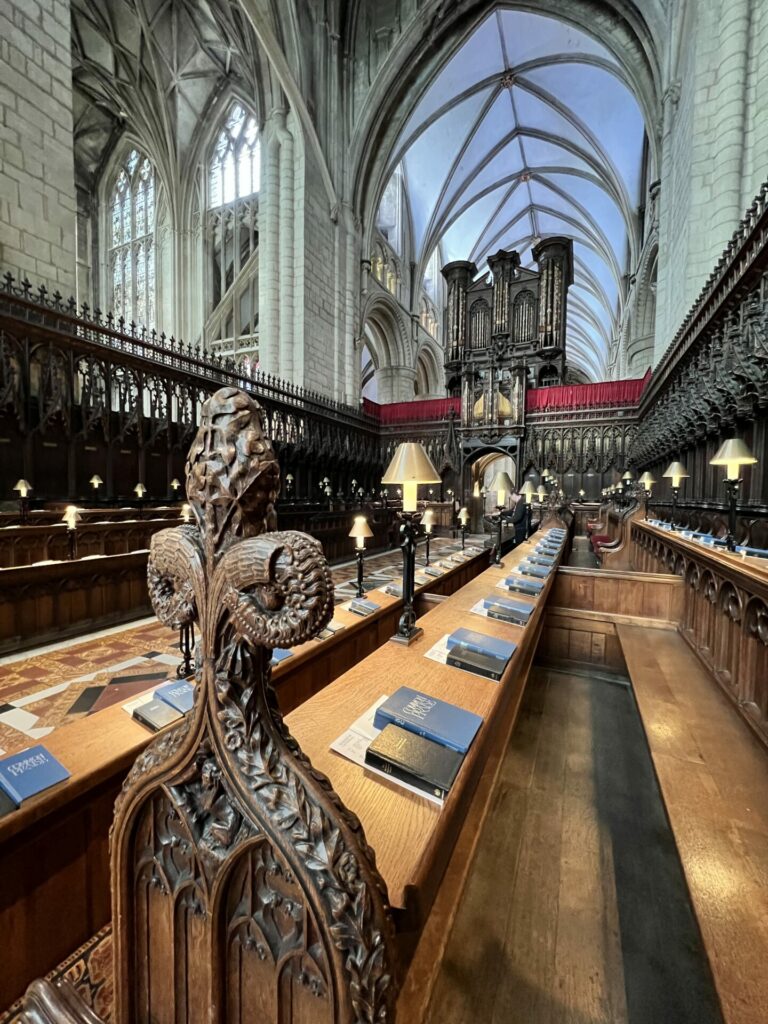
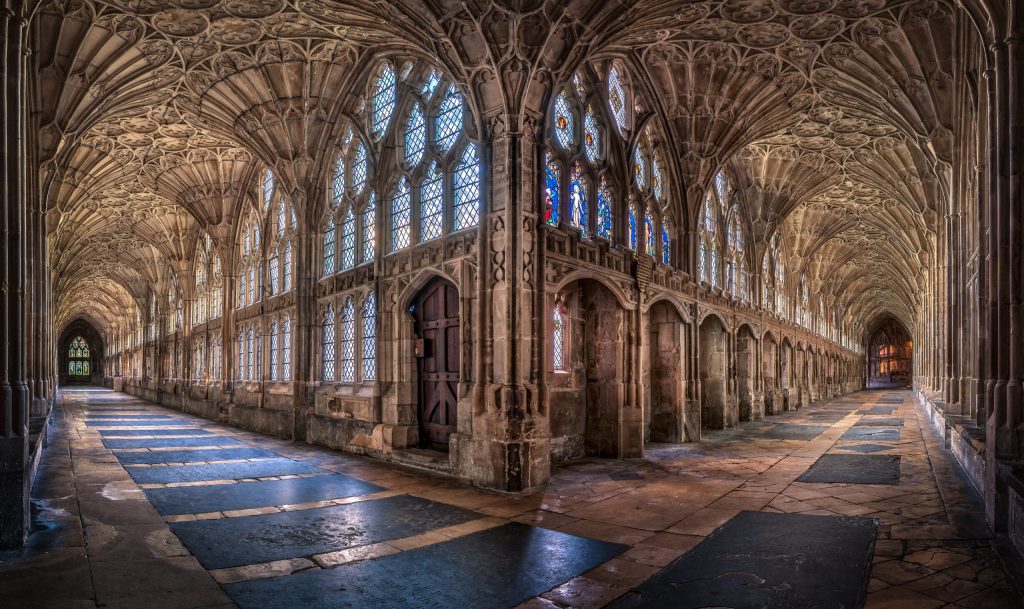
Interior of Gloucester Cathedral. Images © The Tudor Travel Guide.
Thankfully, though, it is a different story when it comes to his son, Henry VIII.
As we have mentioned, Henry came to Gloucester with Anne Boleyn in 1535. The couple almost certainly lodged in the abbot’s lodgings adjacent to the current cathedral and within the abbey’s precincts. The couple remained in the city for around a week as guests of Abbot Parker, whose (empty) tomb can still be seen in the cathedral today. There are records of him greeting the royal couple in the porch of the abbey (which survives intact) and acting as their host for the duration of their week-long stay.
There are so many features to explore in the cathedral that you will want to linger awhile, but be sure to visit the cloisters; undoubtedly, they are the finest in England, replete with an intact lavatorium, where the monks washed their hands before dining. While there, look out for the stained glass in the north aisle. This was removed from nearby Prinknash Abbey in the 1920s. Prinknash was once a country retreat of the Abbot of Gloucester and legend has it that it was visited by Elizabeth of York in 1502 and by Henry VIII and Anne Boleyn in 1535. The stained glass shows the coats of arms of Henry VIII and Katherine of Aragon, alongside those of Abbot Parker, Jane Seymour, Edward VI and members of the Brydges family of nearby Coberley Hall. They are easily overlooked!
After exploring the interior of the cathedral, head outside and around the west end of the building to see the medieval gateway that once led into the inner sanctum of the abbot’s lodgings. There are some lovely old, historic buildings that you will see once through the gateway, including (on your right) a timber-framed building known as ‘The Parliament Room’, part of the original abbey complex.
Sadly, only one wall of the abbot’s lodgings survives; this fronts onto Pitt Street. It is the northern wall of the long gallery. You can see the stone casing of an oriel window, which surely once looked out from the gallery onto the street below. The rest of the abbot’s lodgings were burnt down and then demolished in the mid-nineteenth century. King School now stands in its place.
Martyrdom at the Stake: Bishop Hooper
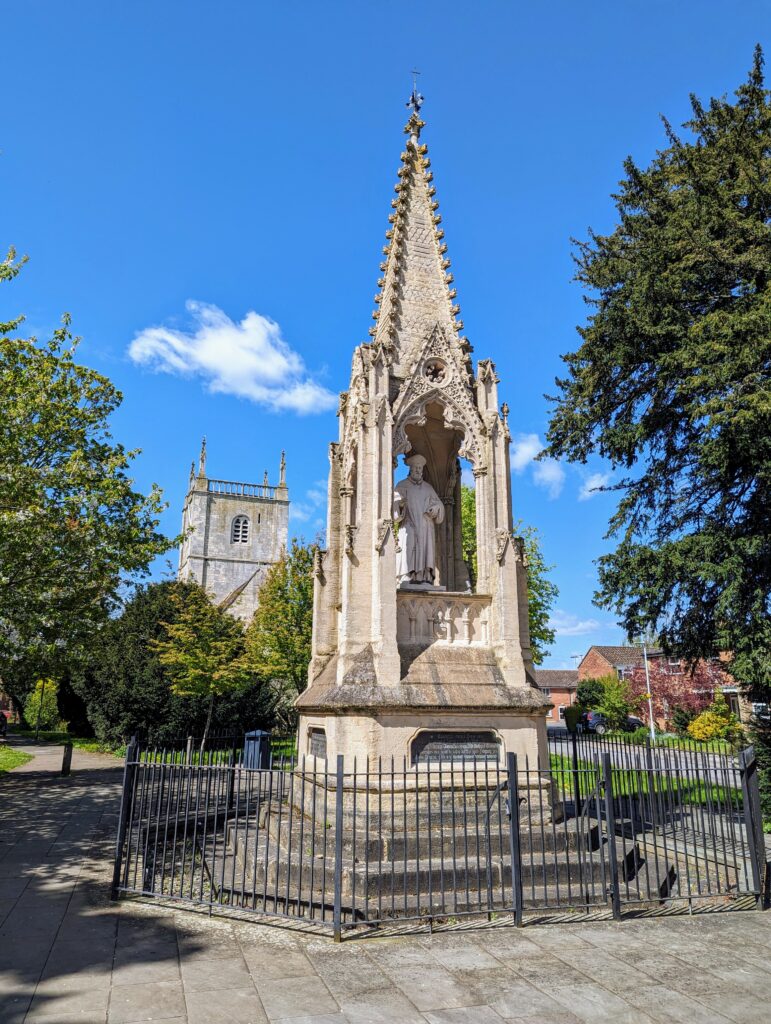
Retrace your steps until you emerge from beneath the inner gatehouse. Look to your right, and you will see St Mary’s Gate. Beyond, you will catch sight of the monument to the second Bishop of Gloucester, John Hooper. He suffered an agonising and gruesome martyr’s death on this spot on 9 February 1555.
An Oxford graduate, Hooper had become a zealous convert to Protestantism during the reign of Henry VIII. Having fled abroad in 1539, he returned home upon the accession of the Protestant King, Edward VI, becoming personal chaplain to Edward Seymour, Duke of Somerset. Thereafter, he took up a post as second Bishop of Gloucester, only to fall foul of the renewed Catholic vigour of Mary I and her Council following the early death of her half-brother, Edward, in 1553.
After a year-long incarceration in London’s Fleet and Newgate prisons, he was eventually stripped of his offices and escorted back to Gloucester to face the horrors of a heretic’s death by fire. The Bishop spent one night in the city before his execution. It is said that his lodgings were in a timber-framed building, now preserved as The Folk of Gloucester Museum on nearby Westgate Street.
At 9 am on 9 February, John Hooper walked the short distance to a place just to the east of St Mary Lode church, where several thousand onlookers had gathered to witness the gruesome spectacle. A botched execution followed. Hooper took 45 minutes to die amidst the flames. An eyewitness account makes clear the horrendous suffering endured by the Bishop on that cold February morning.
Today, the site is remembered via a stone monument, erected in 1862. Interestingly, when the site was being excavated, the remains of a charred wooden stake were discovered, a truly spine-chilling reminder of the events of that day.
Dissolution and Survival: Gloucester’s Religious Houses
While in Gloucester, be sure to explore the remains of two other monastic houses dissolved in the 1530s: Blackfriars (which contains a rare scriptorium/library) and Llanthony Priory. These two are particularly fascinating, both in terms of their history and architecture.
A walk of just under one mile from St Mary’s Square will bring you to a pleasant open park and the remains of Llantony Priory, the next stop on our Tudor trail.
Llantony Secunda Priory
Llantony Secunda was, as the name suggests, the second iteration of a religious order originating in the Black Mountains of North Wales. Following a sacking of this first priory by Welsh rebels in 1136, Walter of Gloucester, erstwhile Sheriff of Gloucester and Constable of its castle, brought his Augustinian brethren back to his home town. Under the guardianship and generosity of his son, Miles, then keeper of Gloucester’s castle, as well as the patronage of a number of the town’s burgesses and traders, the priory flourished.
Over time, it became a significant property owner and was renowned for its lavish hospitality. Henry III transacted business at the priory; Edward II was held there under house arrest on his way to Berkeley Castle, from whence he would never emerge, while a widowed Queen Eleanor strolled in the grounds; however, more pertinent to our story is the priory’s association with Henry VII, who visited the priory on at least one occasion.
Other than the promotion of Prior Dene to the Archbishopric of Canterbury, we can see the King’s close association with the prior hewn into stone. Adjacent to a very busy main road, on the perimeter of the priory, is the original outer gatehouse. The gatehouse was built around 1500, a year before one of the King’s documented visits to the priory. The uppermost window is surrounded by three shields. Sadly, the carved stone is well worn, but I am assured that the uppermost one bore the arms of Henry VII.
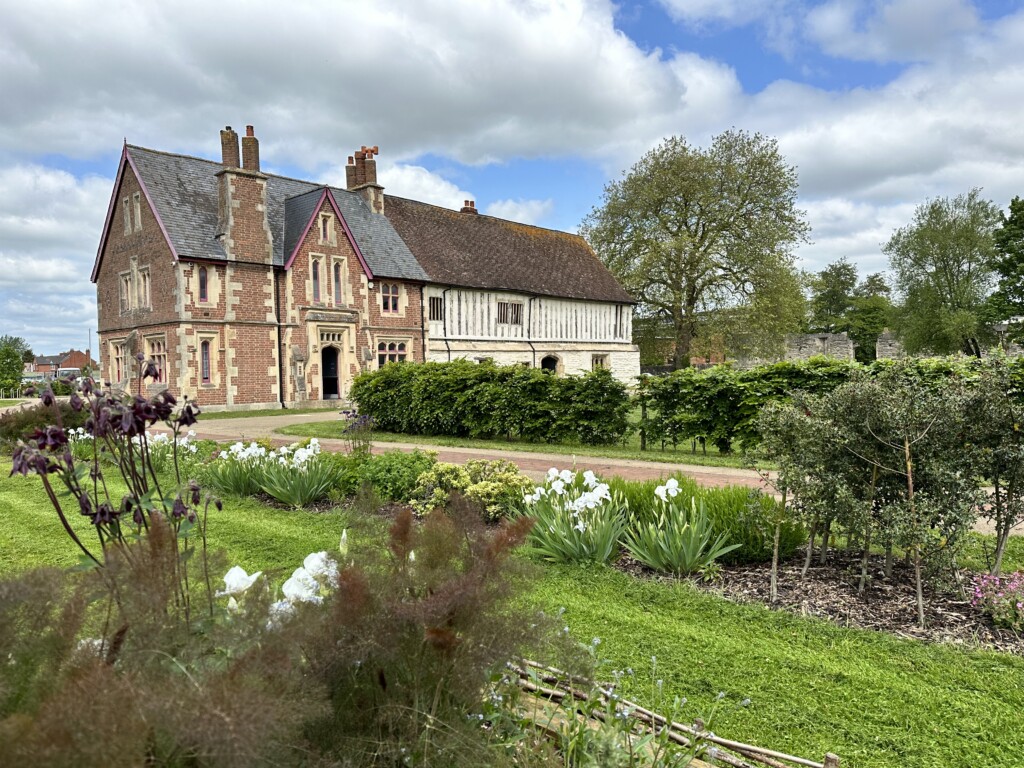
This gateway opened up into the outer courtyard, which contained many service buildings, including the bakery, brewery and dairy. What most catches the eye, though, is the beautiful fifteenth-century range containing six bays, but which once extended to an enormous thirty bays long! Today, the remains of Llantony Secunda have been converted into a museum telling the story of the priory. However, in its heyday, it comprised the lodgings of the priory’s senior canons and a granary.
The grand priory church lay to the east of this building, cutting across the current Gloucester and Sharpness Canal, constructed in the eighteenth century. As Philip Moss points out in his very helpful book on Historic Gloucester, many of the Prior’s benefactors who were buried in the eastern end of the church were ‘swept away from their last resting place’ during the canal’s construction.
To reach our final destination, you will cross this canal and make a short, 14-minute walk to Ladybellegate Street, where you will find one of the best-preserved Dominican Friaries in England.
Blackfriars
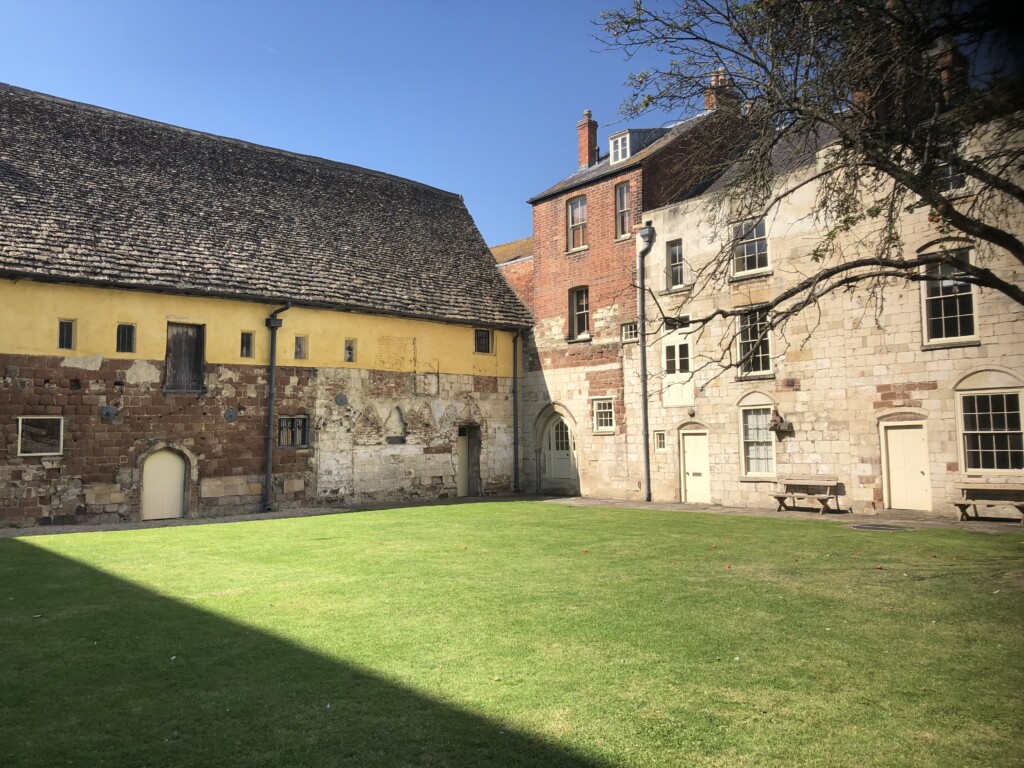
Approaching along the cobbled footpath and ducking underneath the arched entrance of this thirteenth-century priory reveals a very special, if not somewhat chaotic, constellation of historic buildings. This was once the home to a thriving community of Dominican friars who lived at Blackfriars following its foundation as a religious community in 1239. These men of the cloth were preachers who lived either alone or in community, teaching and evangelising their faith to the laity.
Due to its excellent state of preservation, tucked away from the main thoroughfares running through the city, arriving at Blackfriars feels like uncovering an oasis of calm and a real find. You will often be able to wander the precinct alone or with just one or two other visitors exploring the buildings alongside you and sharing in their delightful charms.
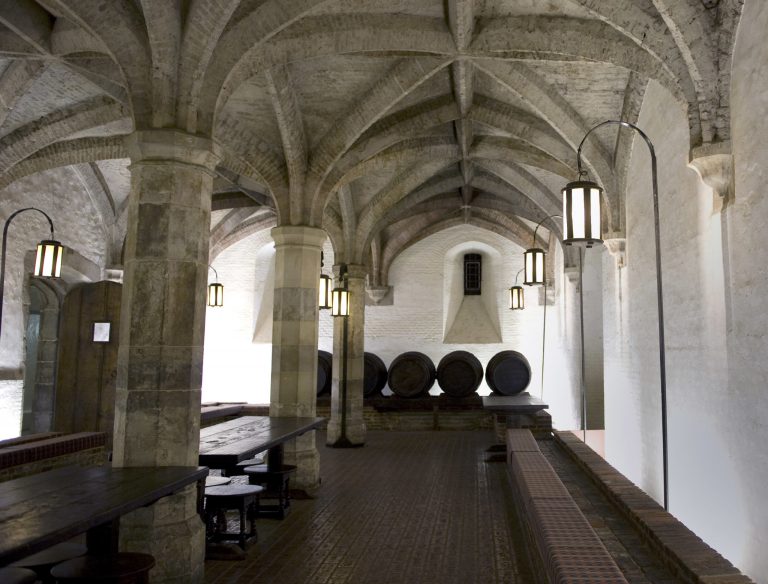
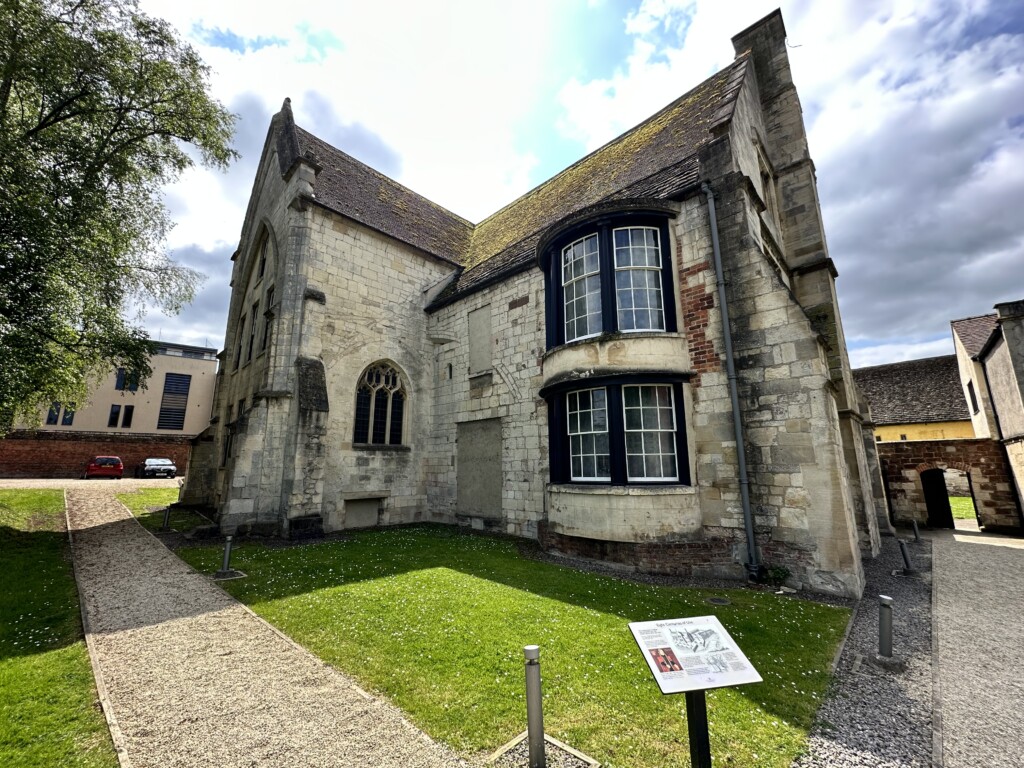
To this day, the buildings remain arranged around a central courtyard that measures some 24.4 m across. To the north lies the grand (albeit now truncated and renovated) friary church; the east range originally contained the monks’ dormitory and chapter house, with the friary’s refectory located in the west range. However, it is the south range which houses the friary’s most fascinating and rare feature.
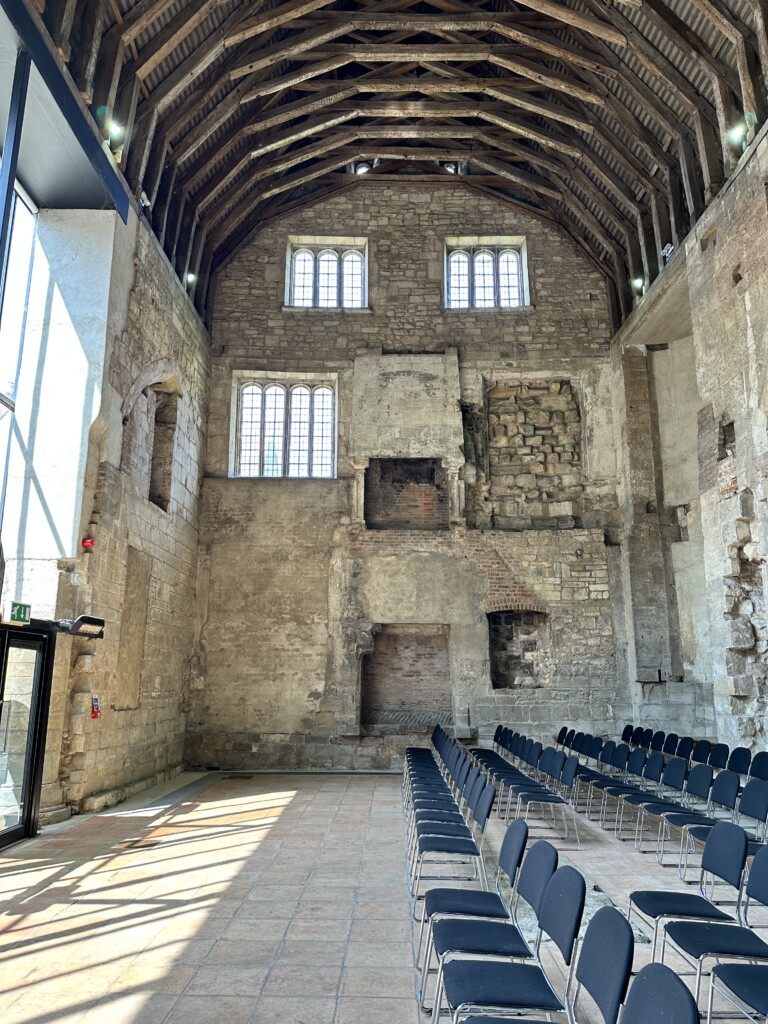
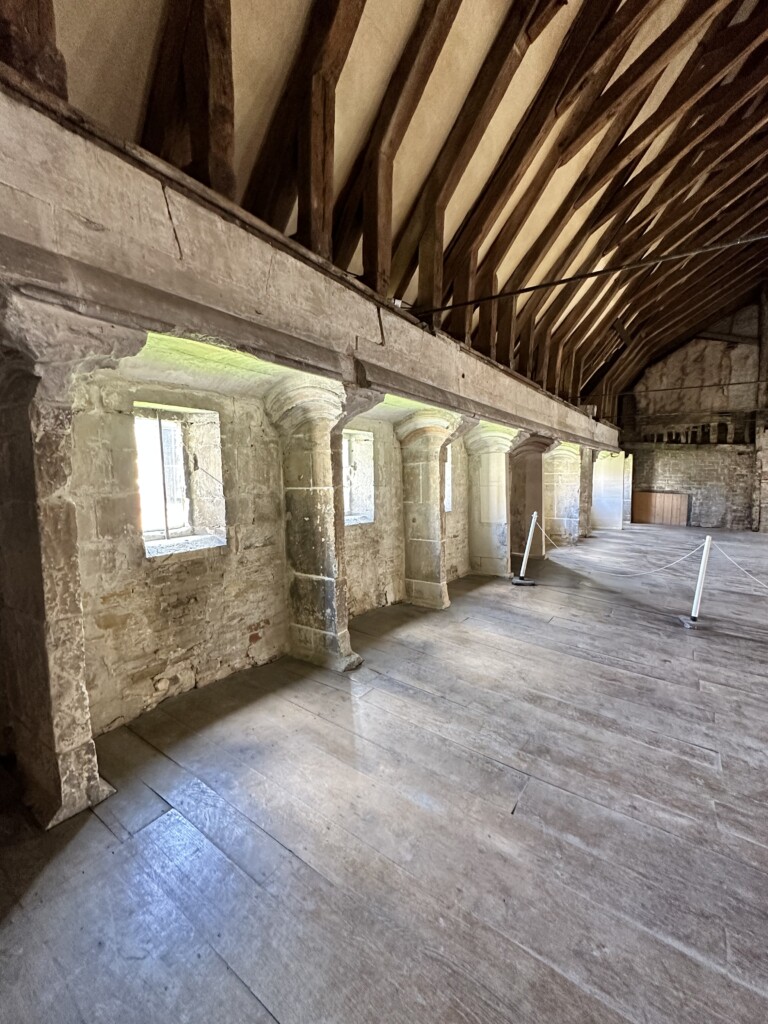
Being preachers, the Blackfriars of Gloucester can claim the distinction of establishing the first purpose-built library in England. This open space on the first floor is now empty save for the presence of small study cubicles or ‘carrels’. Each carrel sits adjacent to a window. Being on the south side of the courtyard, these cubicles were ideally placed to catch the light, facilitating the daily activities of reading, writing, and learning. It’s mind-blowing to think what books might once have been housed there, no doubt spirited away by Cromwell’s men during the Dissolution.
Speaking of the Dissolution, Blackfriars survived largely intact after it was broken up in 1539. It was sold in the same year to Sir Thomas Bell, a wealthy merchant of the city. He converted the church into a mansion, thus accounting for its truncation and the rather bizarre placement of fireplaces, halfway up the inside wall of the old friary church. At the same time, other buildings were converted into workshops, enabling the manufacture of cloth until his death in 1566. Thereafter, it changed hands many times, being subdivided and used variously over time as domestic dwellings, workshops, and even an independent church and school.
Restoration to save this historic building got underway in 1960 and, in addition to attracting history tourists, serves a civic function, including as a licensed venue for weddings.
A City Worth Rediscovering
Though centuries have altered its skyline and scattered its sacred stones, Gloucester remains a city where the past lingers in every corner. Tudor kings and queens walked these streets. Martyrs died here. Great abbots, merchants, and monarchs shaped its destiny.
To visit Gloucester is to stand at the confluence of power, faith and memory. You can still feel it—in the hush of the cloisters, in the echo of footsteps beneath timber beams, in the weathered carvings that outlasted empire.
This is a city that rewards curiosity. It asks you to look closely, to step off the beaten path, to feel the weight of stories beneath your feet. Whether you come for its cathedral, its martyrs, or its merchant past, Gloucester has a tale to tell you—and if you listen closely, it just might take your breath away.